What do we do when political language continues to be ignored by those in power? We laugh. Just as mockery and belittlement are wielded freely by the powerful against the people, humor has long been deployed to critique the elite’s corruption and wilful ignorance, turning their dismissal of the masses as “uninformed” and “nonsensical” squarely back against them. Social activism and the language through which ideas are disseminated are not without their ties to academic culture. Nothing wrong with that. But as political participation spills online, critical expression has taken on new forms. Meme-ification and “shitposting” have thus emerged as weapons of contemporary visual activism. Their resonance transcends generational divides, rooted instead in expressions of particular localities in the design and circulation of political memes.
Meme-making is especially rife in Indonesia, which topped a 2023 ‘global flourishing’ survey issued by Harvard University and several other research institutions. The statistic has since been rehashed into a PR device by Indonesian officials in their diplomatic speeches abroad, manoeuvring around the deeper problems of wealth concentration among the country’s richest. Last March, Kompas reported Indonesia’s ultra-wealthy class has expanded rapidly over the past decade, a reality that officials seldom acknowledge in their messaging to the world. The same complacency taints official responses to corruption scandals, including the misappropriation of over IDR 500 million in aid for Sumatra flood victims. It surfaces, too, in the suicide of a ten-year-old student in Southeastern Indonesia whose family was unable to purchase basic school supplies. And in mid-2025, widely circulated footage of mass looting at politicians’ mansions, captured during protests over an increase in their lavish allowances, offered a glimpse of where some of Indonesia’s “wealth” ultimately flows.
Bureaucratic vulgarities
Morbid imagery bookmarked the looting last year, with fiery protests in urban pulses unfolding alongside expensive homes stripped of their luxury. Anticipating chaos, politicians hopped on international flights as they watched the mob empty their homes through the phone. For average Indonesians dedicating their life to work, the scene exposed how portions of their taxes have funded surplus indulgences that stretch from indoor pools, Fendis, Patek Philippes to Ferraris. The true luxury, however, lies not in the contents of such mansions but in how little it often takes for many politicians to occupy their positions.
This is not to say that the state as an establishment is void of well-meaning individuals. But the performative and absurd nature of state mandates likely reflects the vulgar character of the very people who orchestrate yet remain least affected by them. “Vulgarity” here names a specific modality of power. In Aesthetics of Vulgarity, Achille Mbembe describes it as a force that is performative, excessive, and absurd in its manifestations. It is fundamentally cultural in the ways it is staged and perceived. Aware of its capacity to control an entire population, the state thus enacts and projects its power nonsensically.
The pushing back and negotiation of such power through popular humor can be illustrated in this way: during the looting of a mansion belonging to House of Representatives member Ahmad Sahroni, the mob discovered (alongside other obscene miscellany such as sex toys) an academic transcript revealing his middle school grades, with sixes across most subjects. Policing academic merit would risk reproducing the logic that sustains institutionalization, were it not for Sahroni’s prior dismissal of his critics as “the world’s dumbest people.”
The insult swiftly backfired as internet users exhibited a mix of rage and play by posting edited photos of the politician, mimicking the unseriousness officials display when addressing the public. Brazen attitudes are met with brazen scrutiny. Carnivalesque meets carnivalesque. Having long been subjected to absurd political rhetoric and violence, the masses now find themselves part of the same spectacle, mirroring the same frivolity imposed on them. How, then, does memetic internet culture intervene in, and reproduce, this carnival to confront the banality of power?
Humor as confrontation
The use of humor in participatory activism hinges on its ability to manipulate. Here, satire becomes the tool through which people navigate laws that confine political expression. By tapping into humor’s trivial and instinctive registers, the public discovers an avenue of dissent and relation that subverts institution. Collective humor, an inversion of collective rage that engulfs street protests, becomes a crucial element of activism the powerful still don’t quite know what to do with. Human rights lawyers and defenders cannot fully escape the possibility of jail, surveillance, and torture.
Truthful, law-abiding work is met with deception that is prison or vitriolic attacks: the vulgar violence of wanting to disfigure, incarcerate and humiliate. “Yes, we can go ahead and charge the activist with slander,” they might say of the activist. “Yes, we can arrange a sophisticated network to shadow the trails of acid attacks”, they might say of the protester. But what of the internet memes? How many are there? Who came up with it? Surely, it would be tough work to incarcerate almost an entire nation finding true joy in such laughter. The manipulation of power thus finds its beauty in the seemingly surface-level image expressing all kinds of idiocracy projected by the state. It is the double of the state’s vulgarity.
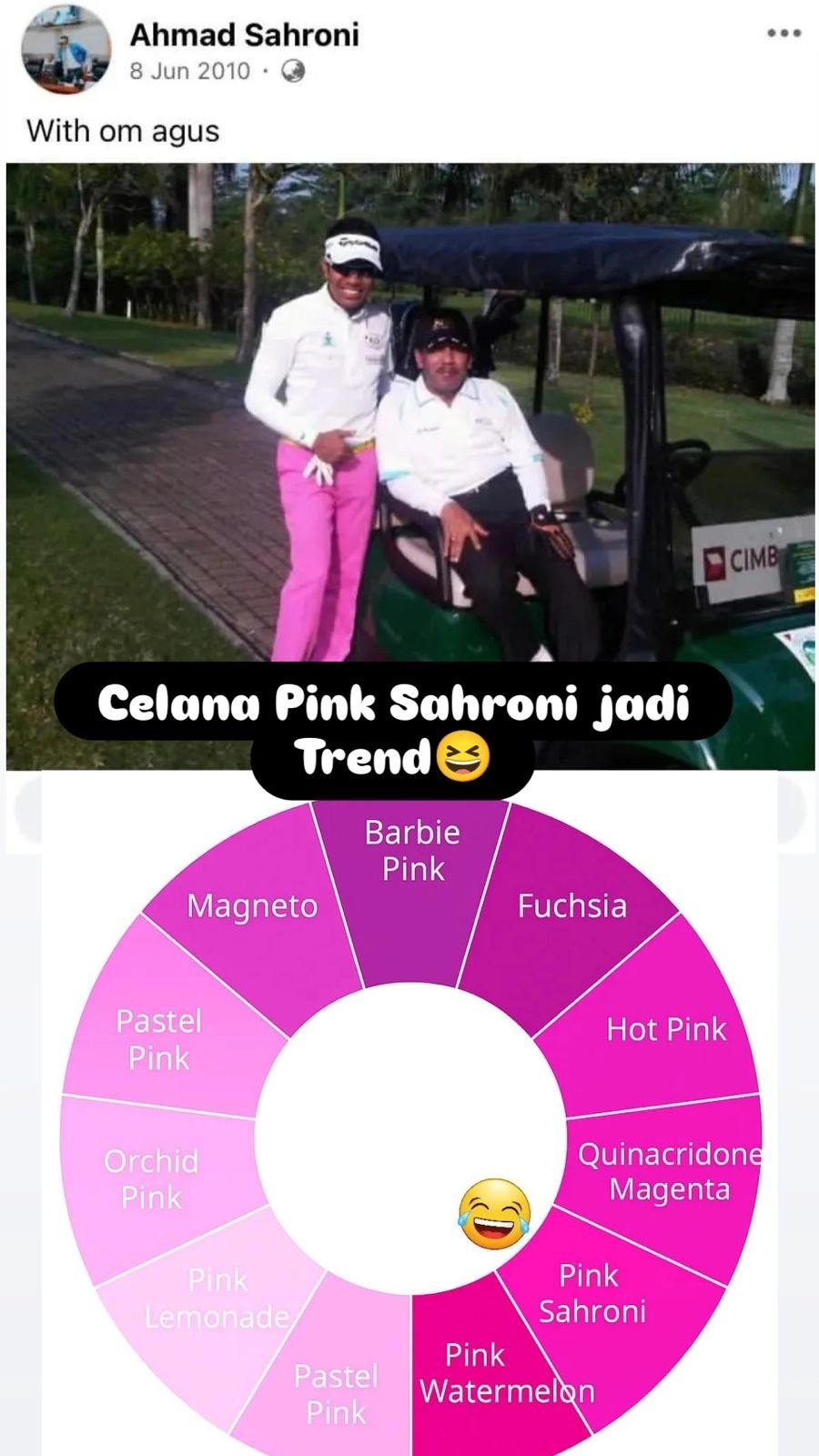
The combustion of political memes appeared to peak during last year’s protests. We may return to Sahroni as an example: in retaliation for being called “idiots” by the politician, the public discovered and circulated a 2010 photograph of him in hot pink trousers, posing beside Agus Suhartono—a retired Commander of the Indonesian National Armed Forces and President Commissioner of the state-owned port operator Pelindo—on a golf course. The image quickly generated a discourse of its own, with some speculating Suhartono was Sahroni’s “link” to the political arena, that Sahroni worked as a caddie, while most commentary fixated on his choice of attire. Little can be said of the political messaging of such discursive imaginaries beyond intent, which was to mock and ridicule. What legal punishments can be levied against such discourse? Calling them defamation wouldn’t be quite right. Is it not merely a matter of the politician’s taste in fashion? Mischaracterization wouldn’t be correct either. That would require the politician to go against himself—his own past.
What can be made of this, if not to let the carnival run its course and die down with time? Mbembe tells us: “By making it possible to play and have fun outside the limits set by officialdom, the very fact that the regime is a sham allows ordinary people to simulate adherence to the innumerable official rituals that life in the postcolony requires… to say the unsayable, and to recognize the otherwise unrecognizable. In other words, the fetish [of state power], seen for the sham it is, is made to lose its might and becomes a mere artifact.”
Investigating vulgarity
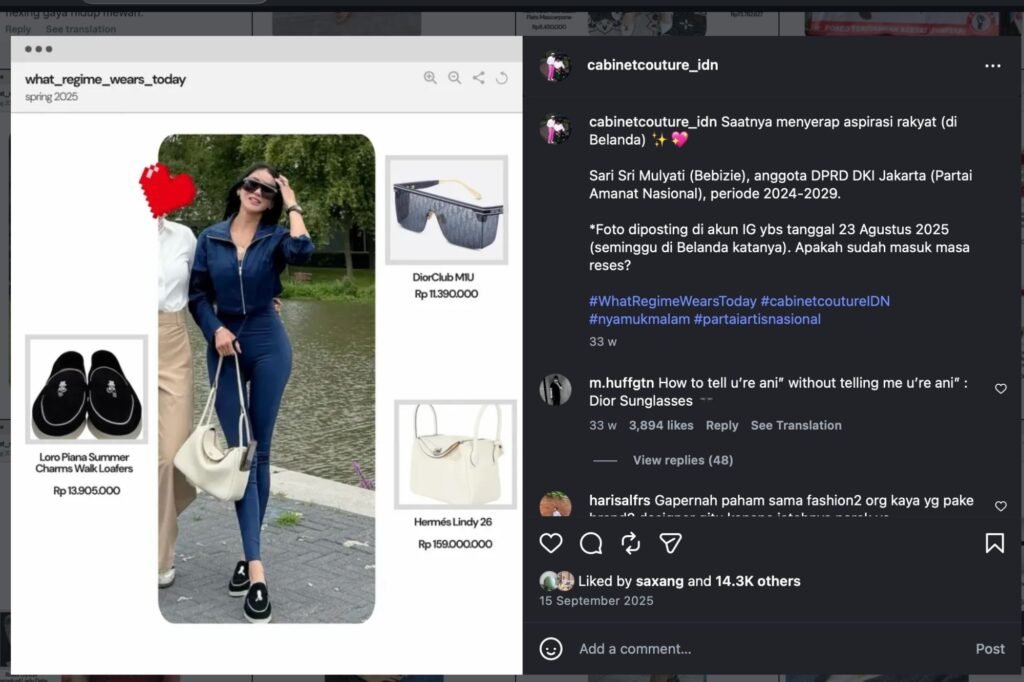
The sham of state power can be observed, too, in the luxury paraded by officials. If hot pink trousers became an icon of silliness, play and triviality—vocabularies contradicting the laws of governance yet pairing well with vulgar power—the grandiose lifestyles displayed by politicians became artifacts of digital investigation, as Instagram page @cabinetcouture documents. These artifacts of indulgence come in many forms, each of its price tag and rightful enjoyer detailed to the public: “A night in Amanjiwo Hotel and Resort: Rp. 18.000.000 – 85.000.000/night.,” “Rolex Sky-Dweller: Rp. 808.431.000”, “Hermes Birkin 25cm: Rp. 622.166.400.” The message behind these disclosures, which is to render explicit the contrasting realities separating the regime’s haven from a world strangled by failing infrastructure and the myth of upward mobility, seems to be lost on many, with observers coming to the defense of ‘old money’ politicians.
But what is concentrated wealth, generational or new, in the face of a nation laughing at both these surplus fetishes and its own profound lack of agency over the absurdities governing its life? What shall connect the House of Representatives with the people if luxe trinkets and holidays are the symbols through which officials are recognized? What kind of relations can be established in the void separating private jets and cronyism with sweat and blood? The social account’s visual narrative is complemented, too, by satirical micro-copies. “From rakyat [the people’s] taxes to runway pieces, from forests cut down to handbags shown off,” the page description reads, its content occasionally reminding audience their taxes engine such splendor parade.
Mbembe observes this of the commandment (a “theatrical” ruling power) in postcolonial Africa, in which it must appear “extravagant,” furnishing “public proof of its prestige and glory by a sumptuous, yet burdensome, presentation of its symbols of status.” Crucially, this spectacle is inseparable from extraction: “To exercise authority is, above all, to tire out the bodies of those under it, to disempower them not so much to increase their productivity as to ensure the maximum docility.” The spectacle of vulgar, excessive power in the postcolony is only possible through extraction. And in resisting the oppressive gaze that labels it part of the “developing world,” the Indonesian elite adopted a hollowed-out version of decolonization which severs itself from history to say, “we are wealthy just like the West.”
Divorced from the aim of liberation, decolonization becomes instead a projection of power, a freak show, an outward-facing economy, and an imperialist lie imposed upon a nation. Enraged Indonesians have found a new name for this, again manipulating the language they were scripted to accept. In a pointed play on words, Indonesia’s Dewan Perwakilan Rakyat (DPR, “People’s Representative Council”) is increasingly rebranded by critics as Dewan Penindas Rakyat—the “Council of People’s Oppression,” a phrase that resurfaces with new accounts of violence. This, too, is a mechanism of refusal. Can the law, after all, tower itself over a tongue-twister?
“Anyone caught yet?”
Laughter sits on the fault line between rage and shock, a juncture that protesting crowds often exploit to interrogate power. In this way, it is also an unlikely passage of hope. Today, millions of public school students have become the public face of Indonesia’s flagship collusion project dressed up as social welfare: the free nutritious meals program, where beneficiaries are regularly served what observers have compared to “prison meals.” The Guardian questioned how a program with an annual budget in the hundreds of trillions of rupiah could produce lunches found to contain broken glass and maggots. In late 2025, Indonesian Corruption Watch published a report mapping a network of politically affiliated and exposed figures with ties or ownership stakes in at least a thousand kitchens supplying meals to schools—revealing clear conflicts of interests.
During a peaceful protest in Nabire, Papua, last year, a member of the state civil apparatus was recorded assaulting a middle school student who had raised their hand in opposition to the program, serving a grim exemplar of what Mbembe described as “the power of the state that seeks to dramatize its importance”, in which “authorities can reacquisition people’s bodies and make them join in the displays and ceremonies of the commandment”, just for the same bodies to be neutered whenever they are thought to be ‘disfiguring’ a public place.”
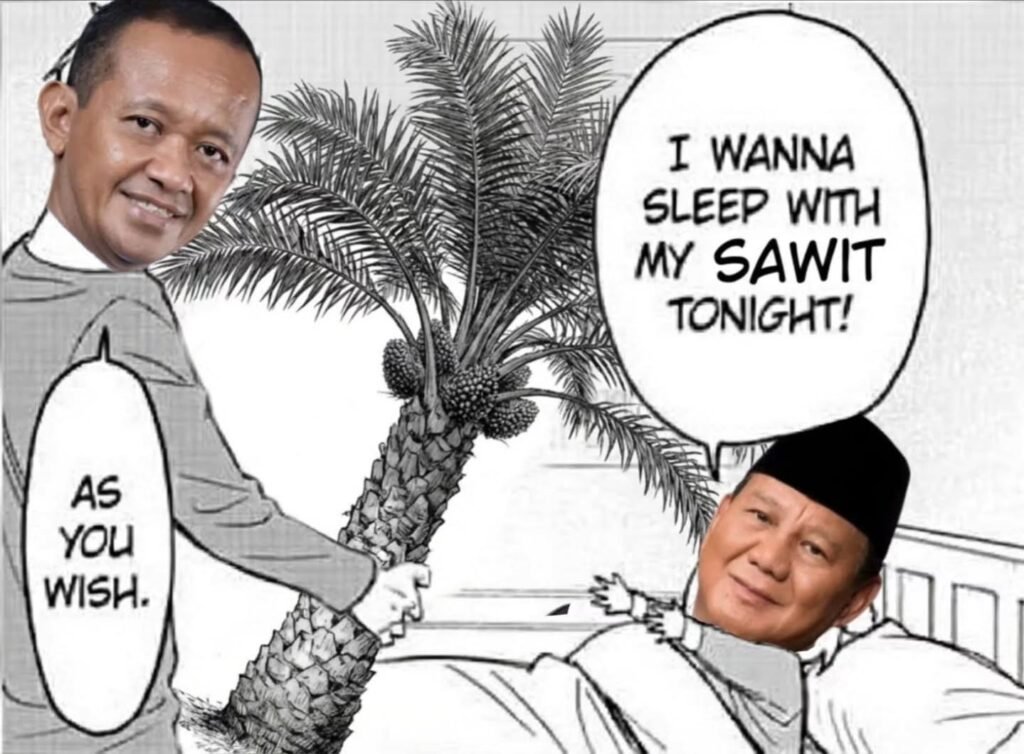
With thousands of students already poisoned by the lunches, President Prabowo Subianto continues to underplay the lack of oversight, favoring instead the aggressive expansion of palm oil plantations. The President’s fetishization of palm oil has seeped into the language used to justify its expansion, most alarmingly in the false equation of oil palm plantations with ‘natural forest vegetation,’ despite their role in driving deforestation; a semantic manipulation activists fear would affect existing laws on forest rehabilitation if left unchallenged. Here, semantics become the arena in which power is contested. In similar vein, many online have twisted Prabowo’s surname into ‘Sawitanto’ (sawit meaning palm oil), taking aim at what they see as a triangulation between the President, the commodity, and Bahlil Lahadalia, Minister of Energy and Mineral Resources.
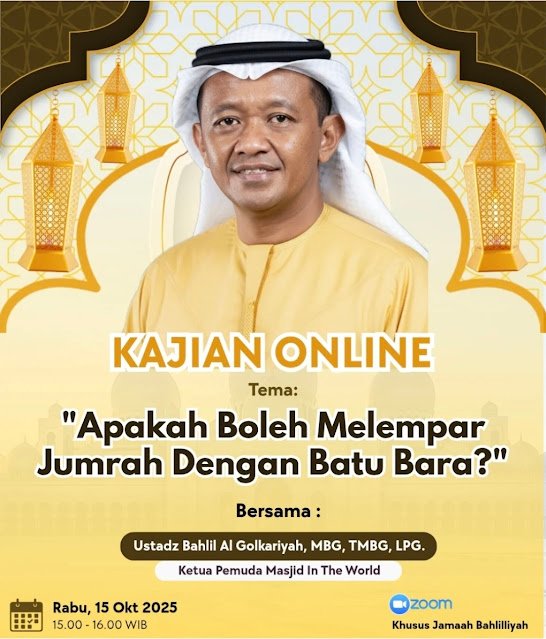
The public’s fluency in deploying memetic language to confront the absurdity of power incited reactions from the establishment, as a political organization affiliated with Bahlil’s party sought to criminalize a satirical poster depicting the minister in religious garb. A made-up question read: “Is it permissible to throw the jamrah using coal?”. The threat of prosecution was leveled too at anyone found to be distributing or engaging playfully with the image, a futile attempt to extend the reach of incarceration and arbitrary violence into the online space. Can the handcuffs, police baton, and vitriol find us there, in a non-tangible world with no masters? Entire comment sections beneath posts reporting the news began to resemble a terrain replicating camaraderie on the ground, strangers bound by little more than a shared appetite for the carnival: “Anyone caught yet?”; “Let’s repost more so we can all meet”; “Let me know which prison cell you’re in.”
Informality becomes the currency sustaining humor in its political function, for how can authorities truly decode or verify the intent behind witty remarks that signify little more than momentum and interrelatedness among the robbed? Can they administer a space where little blooms beyond the repetition of vulgar, nonsensical jokes where the commandment itself is its sole inspiration? In a centerless digital place, the mass strips power of its force by insulating it from its own theater, celebrating in unison as something that is not theirs.***
Editor’s Note
After the publication, the editor amended the text from “What do we do when political language continues to fall on deaf ears?” to “What do we do when political language continues to be ignored by those in power?” to avoid belittling the experience of deaf people. Marginalia apologize for the inconvenience caused.
About The Author