

We have come to live at speed. Is it not the metric through which value and certainty are measured? The faster something produces a result, the more legitimate its validation, and the louder the applause. Speed, then, is not merely a matter of efficiency, quality, or correctness; in practice, the contemporary capitalist order treats haste as an engine of extraction. Its logic is fixated on “more,” which it refuses to recognize as excess.
Speed is progress: a promise made to a black hole of modernization we cannot yet see or understand, but from which we cannot opt out. The speed at which we are expected to operate seems to have deprogrammed us from our ability to wait. We have come not only to compromise our time, but to antagonize it, even as we attempt to impress others with it.
This is nowhere more apparent than in how we are situated within the field of labor. The question is not simply how many outputs you can offer within a given time, but how much you are expected to accumulate within a relatively short period. Seen this way, the governing force of time concerns not only service and production but also intrusion into place and memory: How many establishments have you served in x years? How long or how little did it take you to move between institutions? How quickly did you enter the workforce after school? What happened in between?
We are always expected to be on time. But who really owns the clock? Who sets its terms and architects its context? By what metrics are we deemed late? What are the limits of tolerance and what are the consequences when we cross them?
In Dismantling the Master’s Clock, Rasheedah Phillips problematizes how time has historically been devised as a technology of oppression and torture, particularly and most gruesomely in the plantation grounds. Far from being a textured medium through which we might imagine a hopeful future or remain in relation to our pasts, dominant Western temporalities turn time into an instrument for limiting and policing what remains possible. It contracts the edges of life’s openness.
Time’s Western association with expansion, production, servitude, and appropriateness is therefore estranged from the many events, foreseen and unforeseen, that constitute a life. Time — stripped of its colors — designs life.
At the outset of the book, Phillips acknowledges the ancestors whose stories “navigate the treacherous waters of existence under the watchful gaze of a clock not of their own design,” and whose resilience inspires them to “unravel the tapestry of time itself, questioning its constructs and reweaving it with threads of our own making.”
If history has shown us how timekeeping is used to organize, discipline, and extract from Black and Brown bodies, where and how might we begin to imagine frameworks for a more liberatory relationship with time?
Timekeeping as instruments
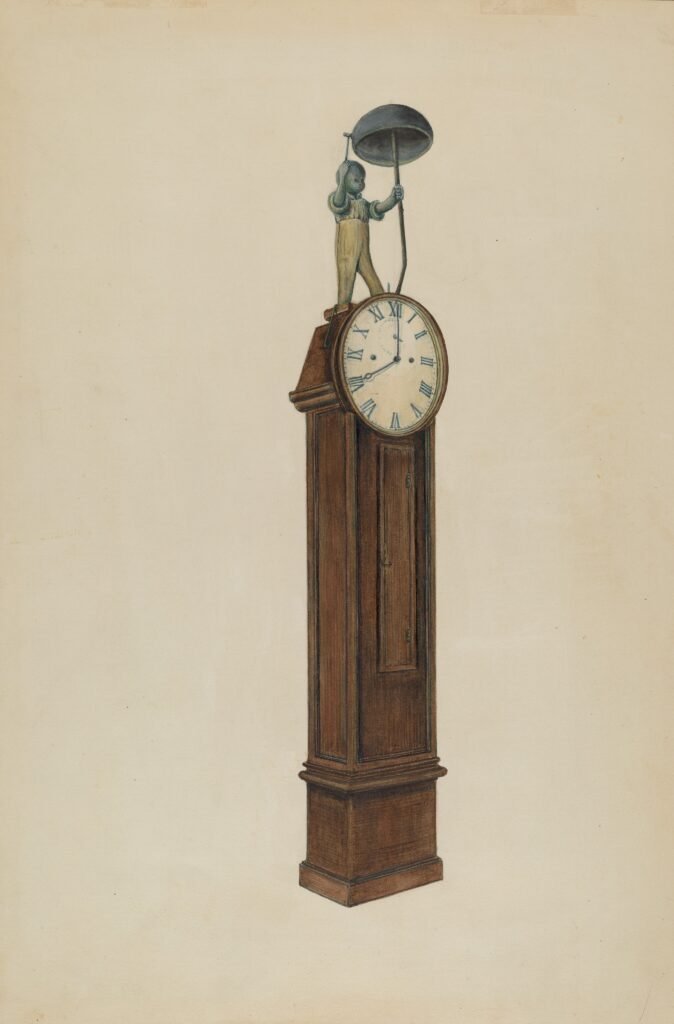
We associate time with autonomy in many ways, most of which are tied to our need for work. It is no coincidence, then, that an entire vocabulary has been invented around work: clocking in and out, putting in overtime, arranging time off, and so on. Likewise, our commitment to perform is often assessed by how early we arrive and how late we stay. For many, the hours spent working become the structure that dictates everything else, including the time we have to rest and attend to ourselves and our communities.
In this way, time is understood as a “singular, linear path” instead of “a web of interconnected moments wherein the past, present, and future coexist and mutually influence one another,” as Phillips elucidates in their book.
Today, an entire language has also emerged to describe temporal autonomy: the desire for a slow life in place of a fast-paced one, in which our labor is strictly monitored and we have little control over the clock. Fundamentally, a visible hierarchy is reflected in the degree of temporal autonomy one has within a larger structure. Those at the top are often perceived as the least available, yet they have others figure things out, respond to matters, or resolve problems on their behalf. In this sense, timekeeping itself constitutes much of their work.
Often, those who set the terms of the clock and determine the instruments by which time is kept ensure that everyone else operates according to their clock, while virtually no one is tasked with monitoring theirs.
The distribution of time, in this manner, can be said to be not only asymmetrical but one-directional as well: time does not apply equally to everyone, nor does it govern everyone in the same way.
This temporal injustice is traced by Phillips all the way back to the transatlantic slave trade, providing a critical lens through which we can question the temporal rhythms that contour our daily lives. They write:
“The historical embodiment of the master’s clock can be traced back to the era of slavery, where the synchronization of time was not just a matter of coordinating actions but a mechanism of subjugation. The master’s clock […] regulated the lives and labor of enslaved Africans, dictating their waking hours, work periods, and brief moments of rest […] enforcing a power dynamic in which time itself became a calculated tool of oppression.”
Phillips argues that this legacy persists in the “global supremacy of Western timekeeping practice, which prioritizes efficiency and productivity over all else.” Time is thus positioned as a technology that governs every aspect of human life, even as it is divorced from human experience and imagination. Its sole history is that of the master’s — the enslaved and the otherwise captive know time, but time does not know them.
Where clock time is marked by certainty and linearity, non-Western and Indigenous temporalities are shaped by relationality to community, nature, and memory, including oral history, seasonal movements, lunar cycles, and animal migration.
Relational, non-Western temporalities, then, are not organized around speed or outcome; they may even stress, as Phillips illustrates with the Ghanaian principle of Sankofa, “the importance of reaching back to historical and ancestral knowledge to construct the future” — placing historical agency and narrativity at the center of time.
Doing time: race, class, and capital
The late anthropologist David Graeber described the shift toward a Eurocentric capitalist clock as both a moral and technological transformation. In Punching the Clock, part of his celebrated work Bullshit Jobs, Graeber explained that, before the fourteenth century, human work patterns were largely unsupervised, even if the relationship between workers and their employers was strikingly unequal.
This is because work, including seasonal farming and large projects such as construction, typically involved an “all-hands-on-deck” mobilization in the form of “intense bursts of energy followed by rest.” Likewise, paid labor such as cooking, meal preparation, and dressmaking followed an arrangement in which “if those at the bottom produced what was required of them, those at the top couldn’t be bothered to know how the time was spent.”
Graeber argued that this pattern of irregularity, with its relative lack of emphasis on temporal subjugation and surveillance, is typical of how “human beings have always worked.” As he put it, there is no reason to believe that acting otherwise would result in greater efficiency or productivity; often it has “precisely the opposite effect.”
The erection of clock towers across Europe during the advent of mercantilism changed this, Graeber proposed, with local merchants going so far as to decorate their desks with human skulls as a reminder that time must be used efficiently. A similar trend emerged during the Industrial Revolution in the late eighteenth century, as domestic clocks and pocket watches proliferated among the middle class, ultimately shaping the perception that time is a “finite property to be budgeted and spent.” Graeber wrote:
“Time-telling devices allowed a worker’s time to be chopped up into uniform units that could be bought and sold. Factories started to require workers to punch the time clock upon entering and leaving.”
Time as an asymmetrical, exploitative technology was thus imposed on the working class, with factory workers not allowed to bring their own time-telling devices. Differences in the experience of time were also evident here: the upper and middle classes stigmatized the poor for using their time recklessly or lazily, part of a prevailing pattern in which our time is perceived as belonging to someone else, whether an employer or a master.
While Graeber’s extensive scholarship on debt and chattel slavery offers little examination of race — situated largely in the Middle Ages, the Victorian era, and war economies rather than colonial conquest as such — his work helps establish a genealogical connection between the wage slavery, or capitalism, of our time and the slave-labor arrangements set out in the Master and Servant Acts of the Victorian era, later replaced by the Employers and Workmen Act of 1875.
The Act, Graeber argued, “aimed to reinforce the absolute right of employers to dispose of workers as they wished.” One ruling, for example, held that a worker dismissed for any act of disobedience, or who quit before the agreed date, forfeited all wages owed for work already done. This mattered because employers often withheld payment for months, even a year, so a worker ruled “disobedient” in one way or another would lose all that unpaid labor, a practice that effectively spoiled “the moral and economic basis of working-class power.”
Clocking out: on temporal relations
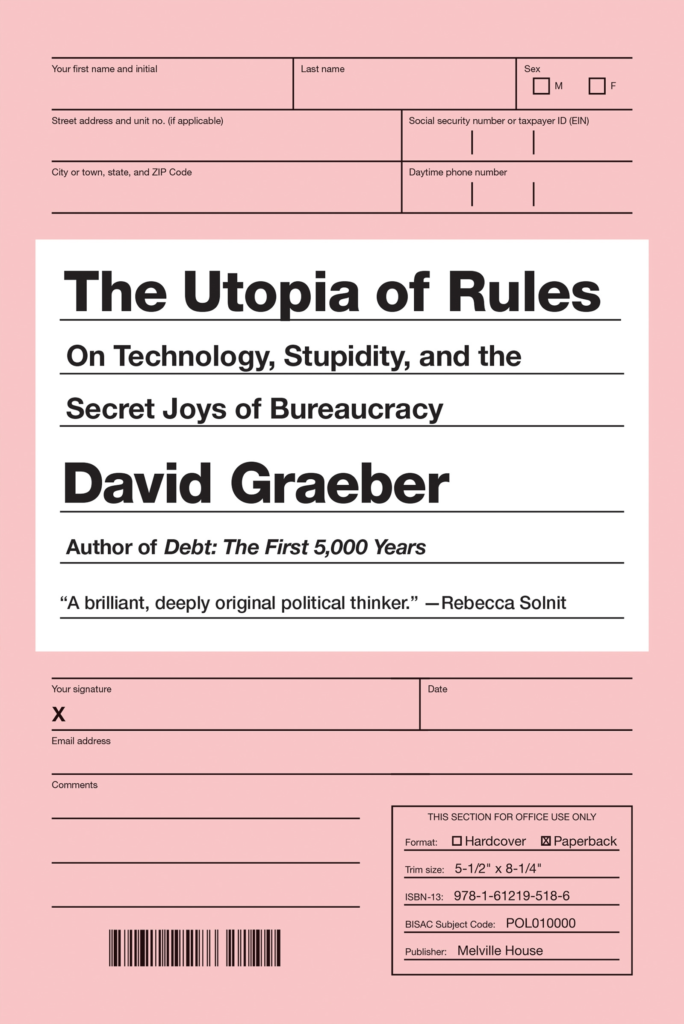
Under wage-labor capitalism, the ubiquity of timekeeping systems — what Graeber describes as bureaucratic technologies — makes our experience of time feel claustrophobic, deterministic, and even stagnant, which is the very opposite of the life we want.
Of course, our experience of time is inseparable from our experience of space, especially the intersecting factors that shape how we embody a space and interact with one another within it. This line of thinking animates contemporary sociospatial research linking technocapitalism to class, gender, race, and everyday life in urban, peri-urban, and Indigenous spaces.
Consider, for example, the “denial of time” experienced by ride-hailing and delivery drivers. They are required to navigate a web of inconvenient circumstances within very short time frames and for very little pay in order to deliver our goods; failure to do so can result in a poor rating or suspension. This is a case of hegemonic temporal inequity that privileges our temporal experience over theirs.
This denial of time is particularly evident in Indigenous land disputes and the exploitative, militarized development of urban margins in West Java, Sumatra, Kalimantan, and Papua, where decades of communal history, labor, ritual, and survival that sustain an entire biological and social ecosystem are disregarded to make way for industrial settlements.
Such contestation of entire heritages and livelihoods rests on the bureaucratization of temporality, wherein one’s relation to space and time is fixed, singular, and legible to the eye of the historically unconscious master: a logic visible in the unlawful deportation of Brown communities across the US and the violent occupation of Palestine.
Is there a way, then, of going “counter-clockwise,” to borrow Phillips’s term? Evidently, there is no straightforward way to revolutionize our relationship with time, which remains “openly hostile” to Black and Brown bodies and working people. But what Phillips and Graeber offer here is a pause to reconsider that our temporal rhythms are far from neutral. They are designed to condition a perception in which the future is “far,” the past “outdated,” and the present “urgent”, rather than one in which all ofthese elements interact with, and shape, one another.
Perhaps the most realistic thing we can do in a world under siege is to practice reparative temporality: to assert political, historical, and contextual agency over our “lost time,” reclaiming it wherever we can, however briefly.
Such learning might help us see what Graeber calls the hidden truth of the world — truths that capitalist masters prevent us from seeing — namely, that our reality “is something that we make, and could just as easily make differently.”
About The Author