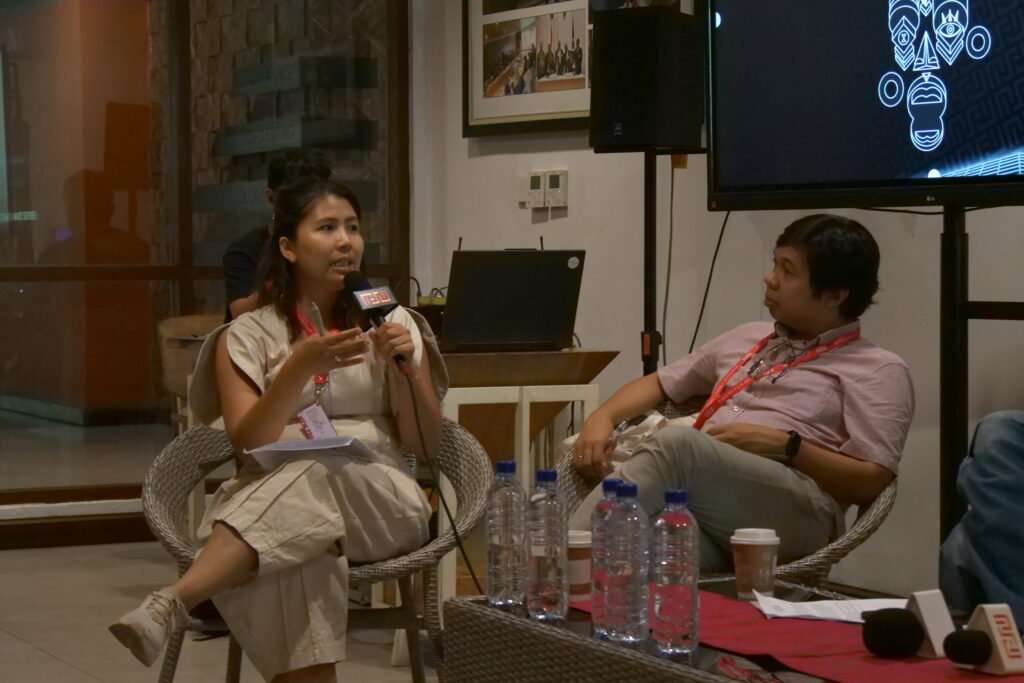
During the 2026 Minikino Film Week (11-18 September 2026), Minikino and marginalia.id presented a special forum for the festival guests to discuss about the state of short films in Southeast Asia. The chosen theme for the event was “Conflict, Impact and Artistic Horizon for SEA short films”.
This forum approached Southeast Asia as an interconnected tapestry, examining how short cinema serves as a vital medium to navigate local conflicts, generate real-world impact, and push artistic boundaries. Adapted from the World Café methodology, this session fosters dynamic, small-group dialogues designed to spark collective insight. Following an opening framework on the regional importance of Southeast Asian short film culture, participants were divided into interactive tables to tackle key questions surrounding thematic trends, dissemination, and artistic evolution. The forum concluded with a shared harvesting session, weaving together individual group perspectives.
The session started with an introduction of key questions by Eric Sasono, a film critic and co-founder of Marginalia.id, and then continued with break-out groups who then reported back to the final plenary session.
Introduction
Southeast Asia began as a geopolitical concept whose boundaries changed over time. The term became popular when the United States sought to define the region during the Pacific War. It later developed into an academic field of study at several universities in the United States, and then into a defence pact established by the United States, which ultimately failed. This was followed by the establishment of the Association of Southeast Asian Nations, or ASEAN, in 1967.
The region’s diversity makes it difficult to view Southeast Asia as a unified whole. There is extreme diversity across Southeast Asia in terms of religions, ethnicities, colonial histories, and political systems. There is no single unified identity because there has been no dominant force in the region.
Moreover, the colonial powers in Southeast Asia were also competing with one another. As a result, they tended to send young “natives” to the “motherland” rather than to colonies elsewhere in the region. Thus, for Indonesians, Leiden or Amsterdam could feel closer than Hanoi or Bangkok, while for Malaysians, London could feel closer than Manila or Vientiane.
Nevertheless, there are a number of important similarities across Southeast Asia.
In addition to sharing histories and borders, Southeast Asian countries have also experienced authoritarianism and dictatorship. There is censorship, as well as sensitivity around certain subjects, such as representations of LGBTIQ people, communism, and regional separatism.
Southeast Asian filmmakers are also highly adept at using digital and low-cost technologies, creating significant opportunities for filmmaking in terms of production, distribution, and networking.
Furthermore, in the early 2000s, Southeast Asia briefly entered a golden age of “independent cinema,” particularly among festival programmers in Europe. This became an important driving force behind international recognition and brought new talents to prominence, giving them an important place in the development of world cinema.
The term “independent cinema” as stipulated by the situation above was later reconsidered from within the region itself. This was to emphasise that Southeast Asian cinema did not begin in the 2000s, nor was it defined solely by European festival programmers. In this regard, popular Southeast Asian films also began to receive greater attention within the academia and activists, in order to examine the development of the region’s film industries and its shared aesthetics- from within.
These similarities and continued efforts provide an important foundation for collaboration, alongside other shared cultural elements—such as latah and kuntilanak, or Pontianak.
Beyond these development, there has been a recent phenomenon that shows that Southeast Asia is more than just a name, and that it has developed into something more concrete than we might have expected: the phenomenon of SEAbling.
The term “SEAbling”—a play on words combining “SEA,” the abbreviation for Southeast Asia, with siblings —suggests a sense of kinship or being in a family. Like siblings, people in Southeast Asian countries often quarrel over trivial matters, such as claiming the origins of rendang, or debating which country makes the best nasi lemak. And that is not to mention what happens when Southeast Asian countries face each other in football matches.
Yet beneath these quarrels lies a strong sense of solidarity among Southeast Asians. The hashtag #SEAbling emerged on social media after an online motorcycle taxi driver, Affan Kurniawan, was killed after being run over by an armoured vehicle used for crowd control during demonstrations in Jakarta in August 2025. His death triggered even larger demonstrations in the days that followed.
During this period, people from other Southeast Asian countries expressed their sympathy for the demonstrators in Indonesia. Through the Grab application, they sent food to protesters as a gesture of support and solidarity. After placing their orders, they uploaded screenshots of their purchases to inspire others and show the forms of solidarity they could offer.
SEAbling resurfaced again at the beginning of this year, when social media users across Southeast Asia became involved in a heated dispute with South Korean netizens, or K-netz. The dispute began over etiquette concerning the use of cameras at a K-pop concert.
The SEAbling phenomenon shows us, first, that whatever form it takes, solidarity and a sense of togetherness among people in Southeast Asia are stronger than we might previously have imagined.
Second, solidarity that usually exists only online can develop into concrete action, although it still depends on corporate-owned platforms, which come with their own risks.
Building on developments like these, I would like to raise several key questions that might be useful for our discussion.
First, as the SEAbling phenomenon demonstrates, how can we build upon the foundations that already exist—in terms of solidarity, a spirit of collaboration, and the various initiatives that have already been undertaken?
Since the early 2000s, there have already been programmes showcasing short films from Southeast Asian countries, such as S-Express, in which Minikino has regularly participated as one of the hosts.
In addition, there is the Association of Southeast Asian Cinema Conference, or ASEACC, a conference that brings together film scholars from within and outside the region who study the cinemas of Southeast Asian countries. For many years, it has served as a space for the exchange of knowledge between academics and practitioners across Southeast Asia.
This list could be extended further, and perhaps it is up to all of you to add to it during this discussion and explore the potentials for further collaboration.
Given all these existing initiatives, how can we build on them and take them further, so that they can become more institutionalised and more sustainable as shared endeavours?
Although the solidarity demonstrated through SEAbling is certainly encouraging, it nevertheless remains within what the scholar Anton Jäger calls “hyperpolitics,” in which people engage in political participation with relatively limited impact.
This presents a real challenge: how can we transform this kind of online solidarity and political participation into forms of organising or activities that have a tangible impact?
This is a major question, and one that film initiatives may need to address by drawing on political theory or the practices of social-movement.
In this context, I would like to suggest several questions for consideration.
How can this solidarity be used to build some form of mutual aid—helping one another during difficult times, such as during natural disasters? In addition to the recent forest fires whose smoke continues to worsen every year, Southeast Asia is also highly vulnerable to natural disasters, with the Philippines ranked as the country most at risk and Indonesia second. How can film, particularly short films, contribute in this context?
Another question: how can solidarity become a tool for putting pressure on governments when fellow filmmakers are facing censorship or political pressure?
Or, how can shared themes and solidarity be used to understand or come to terms with the past? For example, how can Indonesia and Cambodia use film to learn from each other’s experiences of genocide, or other countries facing other atrocities in that matter?
Most of the examples are indeed related to politics. For me, however, they are also connected to conflict in a broader sense, particularly the ways in which citizens come into conflict with their governments.
Here, I would like to invite filmmakers and artists to take a position alongside the people, in which they are part of. The role of filmmakers is important both in the short term—for example, in mitigating or responding to disasters, political repression, severe corruption, and so on—and in the long term, through movements that raise awareness, strengthen solidarity, and foster mutual understanding.
Therefore, artistic achievement inevitably has to be situated within these circumstances, not only in a national context, but also, and especially, within the broader regional context of Southeast Asia.
Filmmakers, programmers, and film activists could perhaps even collaborate at the city-to-city level across different countries to discuss issues that may be shared or similar.
Those might be the starting point for the discussion, just remember we do not start from the scratch.
Thank you for listening.

Discussion
Similarities, Solidarity and Collaborations
Group one focused on similarities, solidarities, and collaborations, which were mentioned in the speech introducing the key question, and came up with several points that are worth discussing further. The first is about the forms and genres best suited to Southeast Asia, which can be connected to “SEA-futurism,” an idea that has been conceptualized in the Philippines for a while. This concept is akin to “Afrofuturism,” in which artists in Southeast Asia engage in speculative thinking to reimagine what the future might look like for the region. The exploration and adaptation of futurism might inspire filmmakers in Southeast Asia to explore new forms and genres.
This idea of futurism might be connected to the second point regarding the regionality of current Southeast Asian nations before colonization. The region was once “united” under Srivijaya and Majapahit, which is to say, there was a time in history when the region was not divided by colonialism. Combining this notion with ideas such as futurism can help us imagine a future for the region that is not governed by or connected through Western colonial frameworks.
The third point is about sharing our difficulties, for example, with censorship and political suppression, through trauma bonding as a form of learning. This is based on the actual experience of one of our group members, who heard about how fellows from other regions go through these difficulties. We imagine this taking place in the form of exchanges, fellowships, and forums at or across festivals, where we share the difficulties we face, what we have done to address them, and perhaps find some form of release. This leads to the fourth idea, which is to create some kind of publication or handbook that would establish human rights practices based on what we learn from these bonds.
The fifth point is to harness technology, and the example we have here is cinemata.org, a user-run platform that opposes big corporations, Netflix, algorithms, and surveillance capitalism. The point of this platform is to use technology that can actually work across borders in the region. There was also a suggestion to create analogue hubs by finding indigenous, sustainable forms of celluloid.
Another suggestion from this group is to promote and assist in increasing the capacity of film festivals in the region, both small and large, to create archives and catalogues. Many of these festivals do not actually have archives of their festivals or a way to share them. Therefore, building a database for these festivals is paramount, especially since these types of archives are not part of national archiving priorities. This can also help in particular situations, such as preserving films that are not allowed in a particular country. In this way, collective archiving might become a regional reality.
The group also suggested that film festivals in the region give awards, recognize, or create sections for marginalized groups as a regular part of their programmes. These groups could include women, LGBTQ people, Indigenous peoples, or any minority groups considered relevant to the festival’s mission. This could also be done at a regional level by providing awards, for example, for Indigenous filmmaking at certain film festivals.
Another suggestion is for human rights groups and human rights film festivals to collaborate with major festivals, such as JAFF, Jakarta Film Week, and Minikino Film Week, so that these issues can be amplified on a bigger stage. The last point from the group is that smaller festivals might be able to pioneer work on human rights issues that we may not be aware of because these festivals receive less attention. We can learn from these smaller festivals instead. These are the points we raised.
Short Film Production
The other group came up with three points regarding the challenges in short film production, including extended working hours and financial benefits, such as fees and insurance. There is an urgent need to create a system that guarantees the safety and sustainability of short film production.
Another issue is the paradox of government funding for short film production for filmmakers who work with it. How can filmmakers maintain their independence while receiving government funding, and is it possible to produce films on sensitive topics under such a funding framework? It is also important to address this matter with audiences, as it could be a sensitive issue. A photo op of filmmakers with government officials could carry the risk of being perceived as a loss of artistic or thematic independence.
Another important issue is the diversity of Southeast Asia, which still needs to be maintained despite the similarities. Filmmakers in the region should present diverse cultural perspectives rather than a homogenized narrative.
Human Rights and Gender Issues
Another group, shared their concerns regarding the intersection of human rights and filmmaking. The group started with concerns regarding (new forms of) colonialism, dictatorship, and rising conservatism, which could serve as unifying forces and common ground for further collaboration between filmmakers, content creators, and international quasi-governmental bodies such as the UN. In this regard, the group suggested identifying issues that could be shared regionally, including human trafficking across Southeast Asian nations and the promotion of gender equality and women’s empowerment despite the current political uncertainty.
Another important point for this group is to develop safeguarding principles based on a survivor-centred approach for women, queer, and non-binary filmmakers, content creators, YouTubers, etc. This initiative is particularly important in the current online environment, which is not safe, especially for women and queer individuals.
Programming and Infrastructure
The fourth group took the discussion deeper into the need to deconstruct mainstream views regarding Southeast Asian solidarity and Southeast Asian infrastructure. This started with the current focus on representations of Southeast Asian films, which often serve as an exercise in “ticking boxes” for film programmers at Western (Global North) film festivals. This box-ticking exercise might not be beneficial for people in Southeast Asia, as outside perspectives might be imposed on filmmakers in the region. The conversation should shift towards building trans-local solidarity among filmmakers in the region to address issues that are important to them.
In this sense, the conversation should include building a film infrastructure based on South-to-South solidarity, drawing on the Afro-Asian Conference in Bandung in 1955 and its subsequent film festivals. This is necessary to challenge the dominance of the Global North in the film industry. The 1955 Bandung Conference and its Afro-Asian Film Festival were intentionally established to challenge the dominance of the Global North, but these efforts were cut short by the coup and counter-coup in Indonesia in 1965, which led to the genocide of members of the Indonesian Communist Party and its sympathizers.
Afro-Asian solidarity should serve as a reminder, particularly of the importance of South-to-South solidarity in building a political imagination that is now relatively absent among filmmakers and programmers in Southeast Asia. For example, it is very difficult to find collaborations between Southeast Asia and South America in filmmaking or film festivals (note: Minikino Film Week has established a collaboration with Bogoshort, the Bogotá Short Film Festival in Colombia).
At a personal level, it is even easier for some film programmers to work with filmmakers, programmers, or film funding agencies in the UK, Australia, or Germany. This happens because there is no reliable infrastructure for South-to-South collaboration.
In this situation, funding from the Global North remains strategic for filmmakers in the Global South. These funding opportunities could still be “hacked” to provide funding for more local and locally grounded filmmakers to travel to major film festivals in the Global North. The funds could also be redistributed to support community-based filmmaking projects.***
This articles is based on the breakout sessions that were reported back in the plenary by: Rizky Rahad (Producer, programmer – Indonesia), Gie Sanjaya (Curator, researcher – Indonesia), Patrick Campos (Film scholar – Philippines), Radhiska Anggiana (Advocacy and communication analyst, UN Women Indonesia – Indonesia), Asti Setiawati Widihastuti (Indonesia UNFPA BERANI II Project Coordinator – Indonesia) and Moderator: Fransiska Prihadi, Minikino.
About The Author