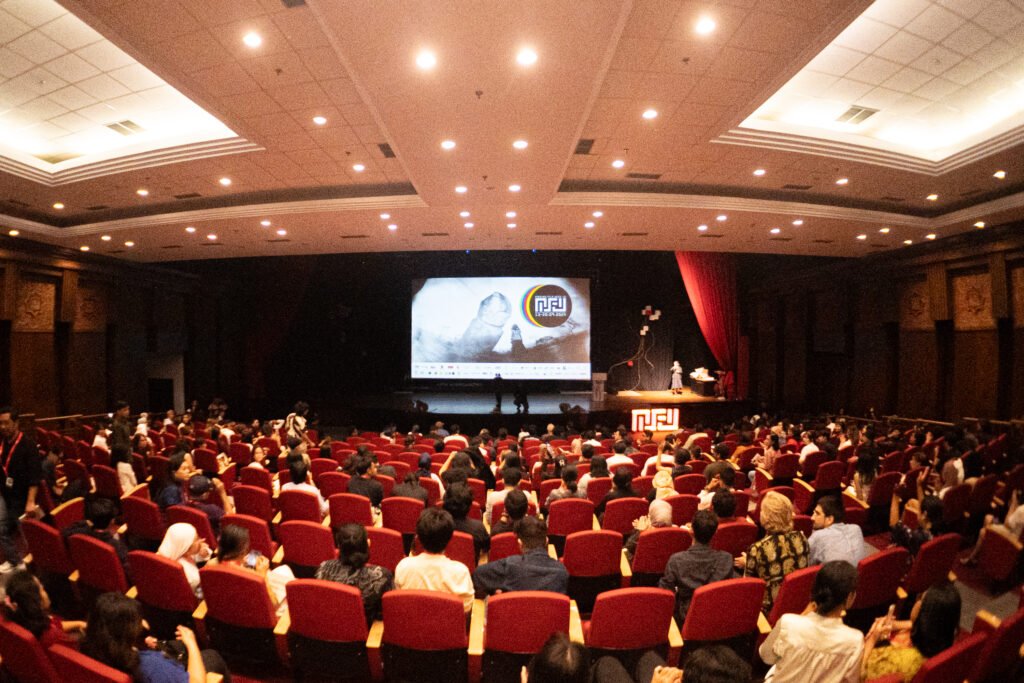
In Denpasar, the base of a long-running international short film festival is also a home. MASH Denpasar, or Micro Art Shop House, as the name already pictures its multispatiality, houses a fifty-seat cinema, an art hub, a small business, offices that run the film collective Minikino, and the residence of Edo Wulia and Fransiska Prihadi, two of Minikino’s movers. During the twelfth Minikino Film Week (MFW), alternatively called the Bali International Short Film Festival, in September 2026, volunteers, audiences, filmmakers, programmers, and the public shared a building where domestic and creative life as well as festival work were entangled, in rooms lined with books, walls with artworks by Edo, and festival keepsakes and merchandise.
During MFW, an actor met at one screening might turn up at another venue; someone would converse with a local attendee in English, another would answer in Bahasa, and still another would translate. These meetings, to a casual observer, may seem accidental. Behind them, in fact, these occasions were inclined, even though everyone had schedules to catch and invitations to other events, making instant cliques with strangers along the way, and bumping into people who had worked together for years. The main screening room is small, but the people passing through it carry the gravity of films, ideas, and relationships brought from distant places.
Short films lend themselves well to such encounters, although they are still often regarded by the uninitiated as preparation for feature filmmaking. In her essay “Brevity–Format–Programme: A Conceptual Triangle,” film scholar Laura Walde argues the short should be defined by its format and the circumstances of its creation, distribution, and exhibition, rather than by duration alone, which is assumed to define the protean form. Brevity allows several self-contained works to share a single screening, their images, sounds, and histories coming into contact without losing their singularity. A hybrid documentary can follow a 2D animation; a family home movie mediating grief can precede a terrifying ghost story centered on a seance. The order changes the experience. Something from one film stays with you as another begins. At Minikino, this principle extends beyond the program, into the organization of the festival and the different worlds its films, people, and activities bring into contact.
Minikino has worked year-round since 2002, its annual MFW growing out of that longer engagement in 2015. Today, a lean, experienced team led by Edo, Fransiska, and I Made Suarbawa is animated by volunteers, loyal audiences, local hosts, collaborators, and supporters from various sectors across a variegated Indonesia, a diverse Asia, and farther afield. The festival feels homey without being casual about its work. Its organizers negotiate partnerships, assemble programs, and cradle ties across years, and these sustained efforts translate to small and big expressions alike, from the sharing of a hearty Balinese breakfast prepared by local shop owners early in the morning, bringing together guests and visitors into an intimate ritual, to envisioning the future of a changing climate by working with NGOs in supporting youthful creativity.
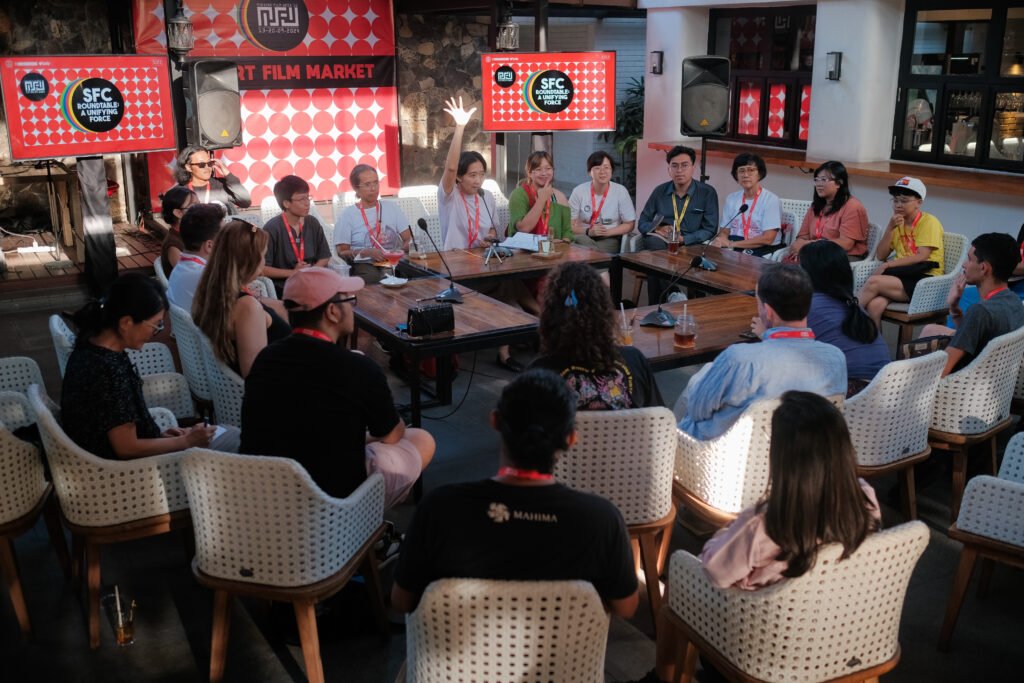
At Minikino, there are projectors to lug around, subtitles to encode, schedules to plot, screening rooms to coordinate, friendships to nourish, and all the practical arrangements that get films in front of audiences. These associations among people, objects, spaces, and practices, of the kind Bruno Latour traces in his actor-network theory, suggests a way of thinking about scale. Beyond size and geographical reach, scale concerns how the making, showing, partaking in, and circulation of moving images bring particular people and places into relation, affecting what can be seen, from where, and by whom. The personal, local, national, regional, and international are not successive territories of increasing size. They inhabit the same room.
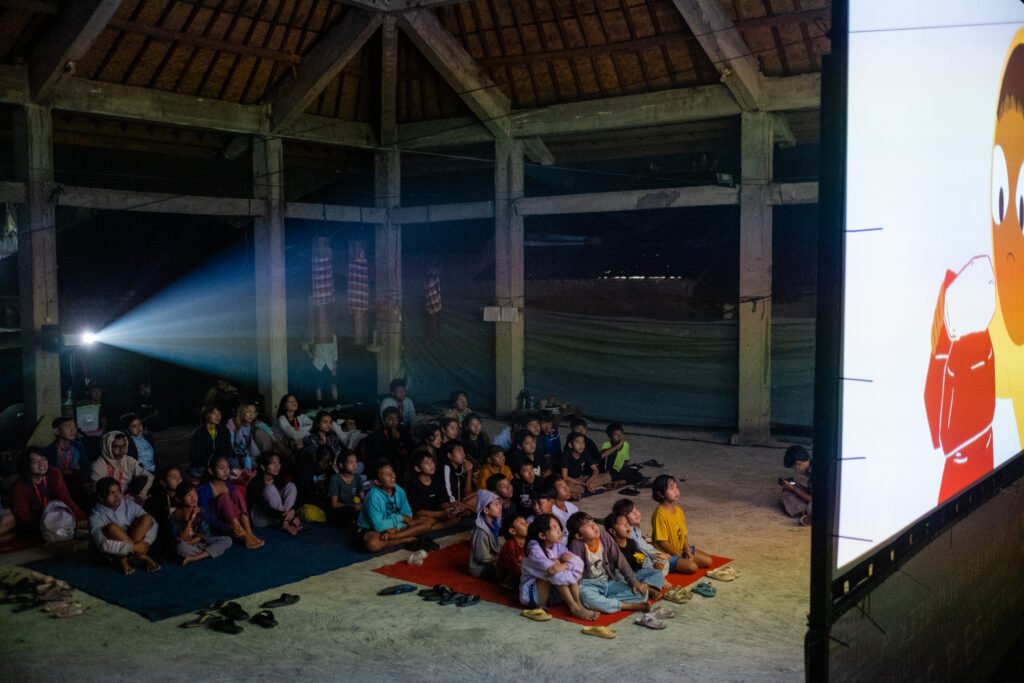
During the 2026 edition, that room could be in North Bali, in Kedai Kopi Dekakiang, a café where the film collective Singaraja Menonton projected films from Malaysia and Vietnam, or the microcinema Rumah Film Sangkarsa in Lovina showing works about young people in Taiwan and South Korea. Schools, galleries, and cultural venues took part, each drawing its distinctive public. At the mall, selections from Bali and Nusa Tenggara played alfresco, accommodating over five hundred spectators, including curious kibitzers; at Rumah Tanjung Bungkak, international films played to serious cinephiles, and at Dharma Negara Alaya Denpasar, spirited conversations were held about industrial trends and emerging practices. Each space required different arrangements of projection, hospitality, and movement, connecting places with established social lives to films and sojourners.
The section Indonesia Raja offers a revealing account of how these crossings alter our apprehension of national cinema. Instead of assembling Indonesian films under a single representative program, the network works with programmers from different parts of the archipelago, coordinated but not controlled from MinikinoMASH, who make selections, develop their curatorial perspectives, and organize exchanges among localities with dynamic and idiosyncratic movie cultures.
In 2026, six programs represented Sumatra, Jakarta, West Java, Central Java, Jogjakarta, and Bali-Nusa Tenggara. Interestingly, the names do not designate territories from which every film originates. The Sumatra selection, for instance, included works identified with Jakarta and Tangerang. A region can also be a position from which to frame cinema, informed by a programmer’s experience, connections, and grounded knowledge. Nor do these localities share equal access to resources. Jakarta and Java retain advantages, while filmmaking communities elsewhere contend with specific circumstances and histories. Through Indonesia Raja, the nation is seen from shifting vantages, none sufficient to represent the whole but none dispensable, as “Indonesia” appears through the discrete wholeness of each program, surmounting the divisions of its official map.
Time offers another measure. Begadang, Minikino’s thirty-four-hour filmmaking competition, asks teams working in and from different places to conceive, shoot, edit, and finish a film within the same narrow span, incorporating peculiar elements. In 2026, these included an umbrella, ice cubes, and a sound heard through only one stereo channel. Scarcity guarantees no artistic value. Yet, when the completed films are brought together, the challenge reveals something of the conditions under which cinema gets made, and the ingenuity of artists under pressure. A posthuman future is imagined in one setting, with a performer dancing the robot. An epic set in a desert is rendered as a tiny comedic duel. Poetic and archival imagery is used to tell a historical vignette of grave political significance. And so on. The largeness of their visions is not dwarfed by the limitations of time and means, reflecting the very gung-ho ethos of mounting a festival like MFW despite the odds. No wonder the Begadang winner is awarded last in the closing ceremony, culminating the evening and the festival itself.
S-Express has kept another rhythm, another history, going since 2002. Initiated by Yuni Hadi in Singapore, Amir Muhammad in Malaysia, and Chalida Uabumrungjit in Thailand, and joined by Minikino in 2003, the exchange had been connecting Southeast Asian short-film programs for more than a decade before MFW began. Its mechanism is straightforward: programmers select films and circulate programs among participating countries, where geographical proximity has never guaranteed access to one another’s cinema, because of linguistic, cultural, and political barriers, especially at the time of its establishment, before the cloud, streaming, and high-resolution video.
In 2026, S-Express included selections from long-participating correspondents Indonesia, Malaysia, the Philippines, Vietnam, as well as the emergent cinema of Timor-Leste. In the Indonesian program, Putu Kusuma Wijaya’s To an Old Harbour follows a Belgian artist witnessing the demolition of a historic building in Singaraja. The fate of one place, with its threatened memory, can thus become part of conversations among viewers who may have never visited the town even if they lived in the same country, much less a neighboring one. Southeast Asia takes shape through these journeys and virtual meetings, its cinematic life extending across borders without ever settling into a single regional cultural identity.
Across Indonesia Raja’s exchanges, in which programmers from different parts of Indonesia bring their histories and commitments to bear; within Begadang’s thirty-four hours, when crews must invent with unequal resources under one deadline; and along the routes of S-Express, sustained by curators and hosts who return to the work year after year, Minikino’s scale becomes more legible in the passionate and committed labor of connecting otherwise separate cinematic worlds and lives, and in the paths those efforts keep open for films and audiences.
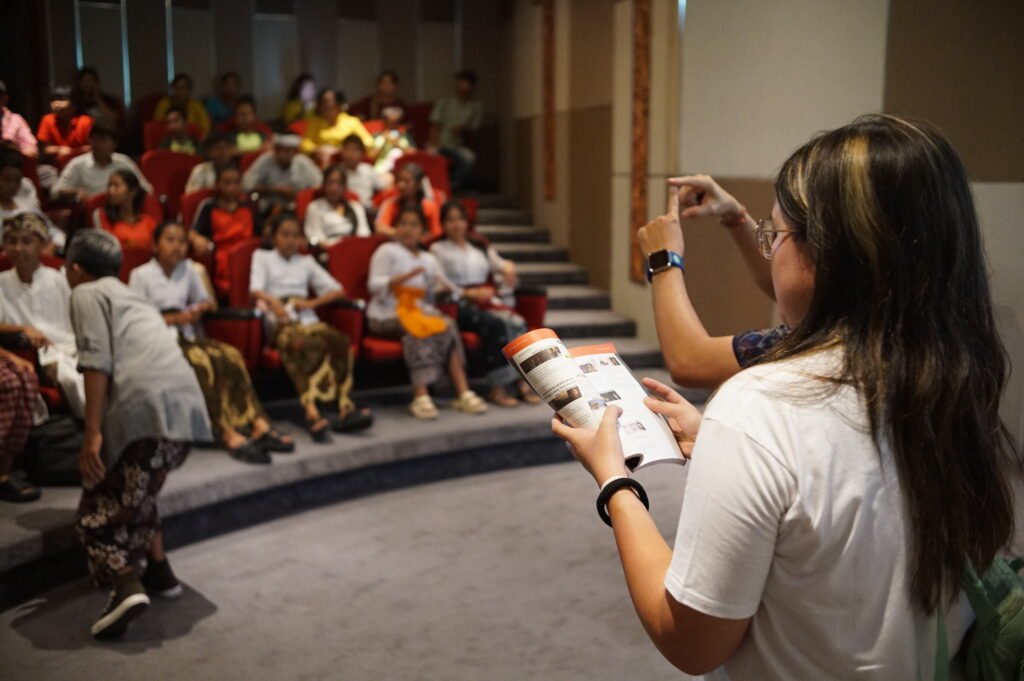
The festival’s national and international competitions participate in this larger movement. In Arief Budiman’s Last May in Theaters, winner of the national competition, two movie ticket sellers inhabit distant cities separated by almost two decades of history: Gwangju during the uprising of May 1980 and Jakarta during the violence of May 1998. Neither participates directly in the events unfolding outside the cinema, but both are marked by stories overheard, happenings reimagined, and the routines they continue to perform. Through testimony, archival fragments, and excerpts from other films, Budiman approaches political violence from the lives of people largely absent from the usual accounts of national struggles; here, the people almost invisible even in the movie theaters where they work, being behind box-office windows whose faces you hardly looked at, become, for audiences, key witnesses to events whose consequences travel across generations and, the film posits, across borders, as the ticket counter serves as a vantage on history.
Another kind of passage occurs in George Peter Barbari’s Birthmark, which received Minikino’s Best Short Film of the Year prize. A woman visits a sex worker in Beirut, their awkward and uncertain encounter gradually opening into unexpected tenderness and shared burden, almost a friendship, born out of a common love. Family, law, religion, and social mores remain present in the intimacy of their meeting, shaping what can be said, desired, or disclosed between them and, more tellingly, between the film and its imagined audience in West Asia and beyond. The screening in Bali stages an encounter involving comparable views on gender and sexuality under Indonesian legal, religious, and social conditions, although the histories and institutions of Lebanon and Indonesia are far from interchangeable. The resemblance appears at an angle, from which a new clarity is achieved.
Seen across MFW, the public violence recalled by Last May in Theaters and the private risks negotiated in Birthmark can alter our attention to the ways political and social life inhabit ordinary experience, colored by our deep-seated worldviews. Neither film explains the other. Viewers carry their different worlds from one screening into the next, from Bali to wherever they came from.
Minikino may not enjoy the resources and infrastructure of larger, more generously funded film festivals. Its work demands constant negotiation, long hours, and contributions that cannot be assumed or infinitely drawn upon. For dozens of smaller festivals across the archipelagos and mainlands of Southeast Asia, where screenings depend on modest venues, local partnerships, and zealous, tireless organizers, there is much to learn from its history.
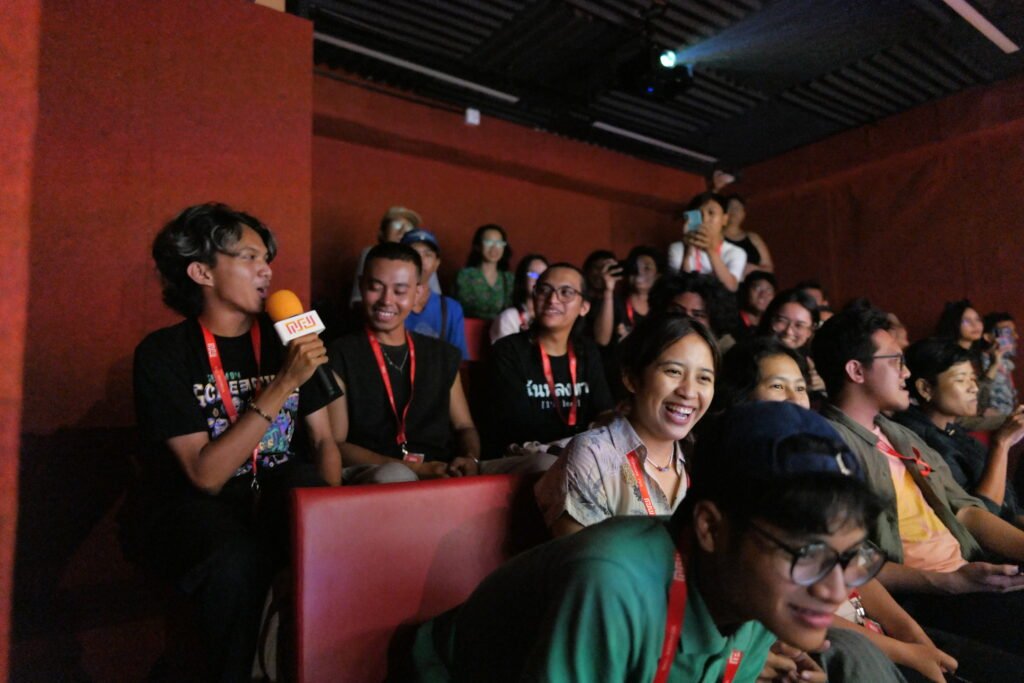
Minikino offers no ready-made formula. Its example lies in the patient development of audiences, the sharing of curatorial and organizational work especially with young people, who often begin from the ranks of viewers or volunteers, the pride in existing community spaces, and the maintenance of exchanges that continue across editions. Such work requires warmth, ingenuity, constancy.
By the final days of MFW, strange faces have become familiar, as separation anxiety familiar to festival-goers creeps in. Some meetings would end with the festival, while others would continue indefinitely through correspondence and collaborations. The routes remain unequal, shaped by funding, mobility, and institutional support, but they also multiply through work carried on after everyone has gone home. A programmer was talking to a filmmaker near the doorway, exchanging contacts. Someone was gesturing for them to come in. Another screening was about to begin.***
About The Author