This is a transcript of the discussion and Q&A that occured after the screening of Turang on the first day of the Indonesia Film Weekend (16th of April 2026). If you wish to read this transcript, we recommend that you listen along with the audio.
Speakers:
Dr Ben Murtagh
Fathimah Fildzah Izzati
Moderator: Eric Sasono
Moderator Eric Sasono (ES)
Thank you very much everyone for staying in the discussion. I want to give you some context a little bit before we start the discussion with the resource person here, Dr Ben Murtagh and Fathimah Fildzah Izzati. Dr Ben Murtagh is a lecturer in SOAS, specialised in film and literature, while Fathimah Fildzah is a PhD candidate in development studies. She’s also the editor of Indo Progress, that’s a progressive journal in Indonesia.
What we are going to discuss is Turang, the film, and the impact of 1965 genocide in Indonesia’s critical intellectual discourse in Indonesia.
Before the discussion, I’d like to give you some context, how we found the film, how Bunga Siagian, the daughter of the director, Bachtiar Siagian, found the film.
As you probably know, in 1965 there was a big communist purge in Indonesia, in which hundreds of thousands, if not millions of people were killed because of their membership to the Indonesian Communist Party, or some of them even not really members, but sympathisers, labour union people, leftist intellectuals, also some Chinese Indonesians. It was a big purge, and it became the foundation of what we call the New Order, led by the late President Suharto, who was in charge for 32 years in Indonesia from 1966 to 1998.
It was not only the killing, the genocide of the Indonesian Communist Party and its sympathisers, but also what followed, the banning of the works of art from leftist artists, from leftist intellectuals, and we even have laws that forbid the teachings of Marxism-Leninism in Indonesia since 1966, and I think it’s until 2000-something, but then it was reinstated again by the new Penal Code in Indonesia just recently. So it’s basically forbidden to teach Marxism and Leninism in Indonesia.
So that’s the historical context, and how Turang is and Bachtiar Siagian was jailed during the purge. He survived, but then he was jailed in Buru Island. Buru Island is the penal colony of Indonesia established by the New Order. He was jailed for 12 years there without any trial, just like thousands of the Communist Party members and sympathisers. This film was gone along with other Bachtiar Siagian’s work, and also some other leftist artists’ and filmmakers’.
Turang is quite important in Indonesian film history. The film is made in, you know, the mountainous area, which is quite far from the big cities. It was quite a hassle to bring all the equipment to go there. So it’s a big production, basically, that I wanted to say. And it won the prestigious award in the Indonesian Film Festival in 1960, the Best Picture and Best Director for Bachtiar Siagian, but then the film was gone.
But there was a record that the film was screened in the Asia-Pacific Film Festival in Tashkent, Uzbekistan in 1958. And based on that, there was a record about that, and Bunga, Bachtiar Siagian’s daughter, was participating in a Documenta in Kassel, Germany in 2022. There she met a friend of hers, who is an artist from Uzbekistan, from Tashkent, and she just asked this artist, ‘can you help me to find Turang?’ Because there was a record that the film was screened in Tashkent at one point.
Based on this, this artist started to ask around the whereabouts of this film. And then it happened that the film, after the screening, the film was very well received by the audience in Tashkent, and some buyers approached the producer at the time. Buyers from Soviet Union and from North Korea approached the producer, and they bought the film. They purchased the film, and then they keep it in Gosfilmofond, that is the biggest archive in Russian Federation nowadays.
And they (the Tashkent artists) found the record of the film titled Turang, but there’s no director’s name in it. Bunga then worked with some institutions in Europe, trying to get the film. It was difficult at the time, because it was just start the Russian-Ukrainian war, and they don’t really trust any approach from the European institution until then, after a year, they managed to get a copy of the film, and then they can verify this is the lost Turang.
And then that’s how we get the film. I think that’s the context of how the film- it’s quite an interesting story in itself, how the film is found.
After Bunga found this film, she started to do some kind of a touring of the film, asked the film communities all around the country to screen the films. So, for a year in 2024, they screened (it in) so many film communities and enthusiasts. Yeah, that’s the context of the film, how we found the film, how Bunga found the film.
So, we’re really grateful that Bunga gave us, grant us the right to screen this film. This isn’t the first time (Turang was screened in London).
Okay, now we have the two distinguished speakers here.
I think I’m going to give it to Ben, the chance to speak, especially because Ben and I have been studying Indonesian cinema for a while. For Ben, I think it’s already for decades, and we heard, we read a lot about Bachtiar Siagian and Turang, but we never really watched the film.
We never really know what the film is about. So, how do you find the film, Ben, so far based on what you just watch?
Ben Murtagh (BM)
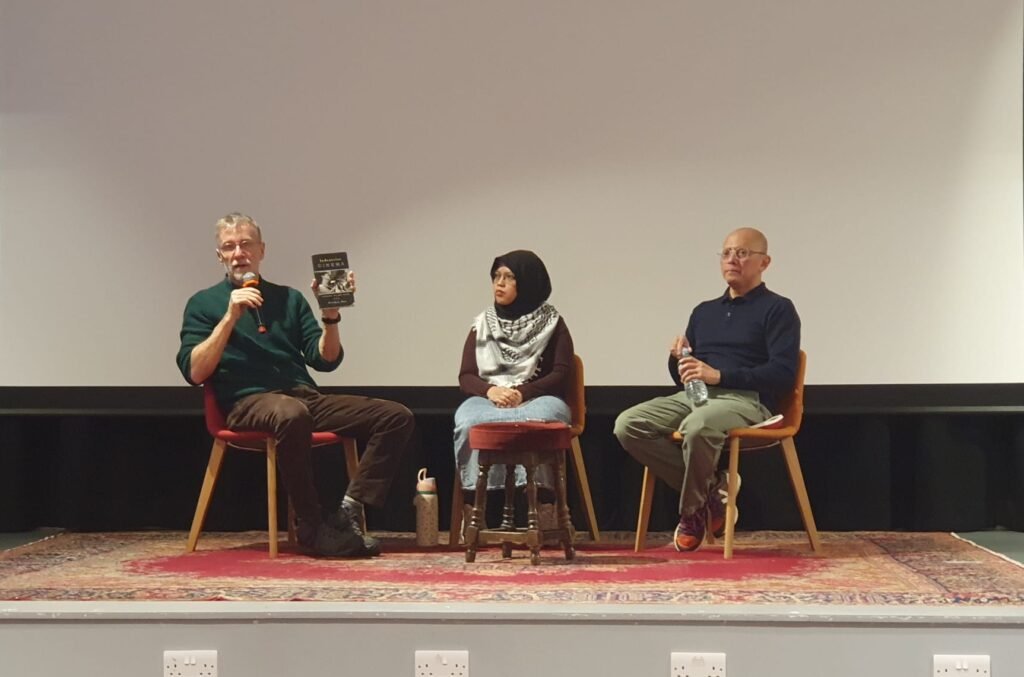
Yeah, so if you studied Indonesian cinema, I guess until 10 years ago, this book here, Indonesian Cinema, Framing the New Order by Krishna Sen, who’s a scholar from, based in Western Australia. So, she wrote this key book, it came out in the early 1990s.
And it was the main English language book, at least, which actually discussed films rather than talking about the industry and so on. And she has a chapter in the book, which looks at, what’s it called? “Political polarisation in cinema”. And what she does in this chapter is quite interesting.
She discusses Usmar Ismail, who is like the father of Indonesian cinema. Sinematek, the building is named after him. There’s like National Film Day in Indonesia, which is named after Usmar Ismail as well.
So, she discusses his films. And we’ve shown a few of them here at SOAS. I’ve used his films on my now-defunct ‘Indonesian on-screen’ module and so on, as a way of showing films from the 1950s and 60s.
And then she also discusses Bachtiar Siagian, but she never watched any of his films because there weren’t any. So, she had to do a, what she does is a reconstruction of his films based on scripts, reviews, and interviews with people, and also with Bachtiar himself. But she never had the opportunity to watch any of the films.
So, it’s really quite an interesting way of doing a film history, discussing the films. I guess one of the questions when we discuss LEKRA, so the Lembaga Kebudayaan Rakyat, the Institute of People’s Culture, which was the Communist Party associated, is like the cultural wing of the Indonesian Communist Party, but not the same. And Bachtiar was a member of it.
And there’s been some useful studies of LEKRA. And when it comes to literature and even theatre, we have some of the texts. But one, the great problem with studying the cinema, cinematic output of LEKRA is obviously we couldn’t watch anything.
And one of the questions was, is there actually a leftist aesthetic? Is there a LEKRA aesthetic, which we can differentiate from the Usmar Ismail aesthetic and the more nationalist aesthetic and so on? And to be honest, when it comes to the… Some people in the audience may disagree with me. When it comes to the literature, I don’t think that the LEKRA literature is the highest moment in Indonesian literary history. It’s extremely political, generally.
And maybe it’s politically… The politics came first and maybe the aesthetics and so on came after. And the question is, so we read about these films, but what do they actually look like? And now we have the chance to actually watch this film. And I don’t know if we’ve got a LEKRA aesthetic.
I don’t know if we have a leftist aesthetic in this movie. But we certainly have a really accomplished filmmaker and what I would say is a remarkably beautiful film. But certainly I’d say we can also see a clearly, I think, a much more socially concerned of the people concerned ideology to the movie, which we probably see less of in Usmar Ismail’s films.
His films tend to be much more… Generally, the hero is probably going to be from a higher class, maybe more metropolitan. And yeah, maybe a little bit more bourgeois, one might say. Whereas, at least with this film, we’ve gone to the countryside, we’ve gone to the Karo highlands, we’ve got parts of the film in Karo-Batak language, which is also a really interesting thing about the film.
It’s not wholly in Indonesian language. Yeah, so I guess that’s what I’d say about the film. And then I’m now going to pass back to Eric and you can ask another question.
ES
Yeah, interesting, Ben. I think we’re going to explore a little bit more about Usmar Ismail later, the comparison between these two big names in Indonesian film history.
(To Fildzah) But before that, I recall that you wrote something about the film and mentioned about the collaboration between the military, the freedom fighters.
Indonesian military is already a military at the time. And the villagers, something that you think it’s quite… Just like Ben said, it represents the socially concerned themes in the film. Can you elaborate that a little bit more?
Fathimah Fildzah Izzati (FFI)
Thanks so much, Eric.
First of all, it’s an honour for me as a regular cinephile and Marxist-feminist to talk about this movie made by a leftist director Bachtiar Siagian. So it’s an honour for me. And yeah, so this film, for the context, this film was made in 1957, just two years after the Bandung Conference, or we Indonesian know it as Konferensi Asia Afrika.
So like a defining moment of anti-colonial and anti-imperialism struggle in the world. So I think this movie Turang, this film Turang, is really embodied this spirit, the Bandung spirit, by portraying the anti-colonial struggle from the people, militia point of view, and not from the heroic point of view as always depicted by the later movies, and always centred in Java Islands. And this one is from Karo in Batak, in Sumatra Island.
So this film is very… yeah, because the point of view is very different from any other independence or any other anti-colonial movies or films. These films, I think, highlight that resistance, like anti-colonial struggle, does not always appear in heroic form, something like that, but also it’s embedded in the creating of the… in the making of the everyday life. So that’s why I think what really centred the heart of this film is how Bachtiar Siagian highlights collective roles of the people, militia, and the villagers, with some emphasis on women’s role, with… yeah, this film highlights the often… the forms of the often invisible labours, which are essential for prolonged struggles, such as tending the corpse, and then cooking, caring for the wounded fighters, and then many other things, including hiding the fighters from the colonials.
And yeah, but at the same time, I think what makes me quite disappointed, but it’s okay, because we can look at the context by the time, right? But yeah, for me, it’s quite disappointing that Bachtiar Siagian still portraying women’s role, especially Tipi, as a back of the men’s fighters, like she’s not that involved in really strategic meeting or something like that, but just rather doing menial tasks, which is also very important, but I feel like since you can make a film, why not you just like creating such a scenario that, you know, portraying Tipi as the heroine, so yeah, but it’s not like reducing the… what is called the meaning of the film itself, so yeah, I told Bunga in person, like, so sorry, but I feel like maybe Bachtiar Siagian could do better in portraying women in this film, and if you see.
If you remember the scene where two people militia talk about how they want to involve Tipi or not, like Tipi was not very, like, you know, involved in it, like she was just like outside of the conversations, but you know, it’s pretty disappointing for me, like, why you don’t ask Tipi, like, to talk together with you, three of you, like that, but yeah, that’s the thing. But for me, apart from that, my critic as a regular cinephile again, I think this movie is very beautiful, especially in depicting the often invisible labour, as I said before, like attending the course with wide shot and everything, like, it’s very beautiful, so it’s like portraying, yeah, the anti-colonial struggle is very beautiful. So I think that’s not the case for many other movies, especially after, from what I watched in my, yeah, my adult years, like many movies in Indonesia, the anti-colonial struggle from the ABRI1 perspective, so they just, like, highlight the military officer as the hero and not the people which sustain the struggle itself, so yeah, maybe that’s the first. Thank you.
ES
I mentioned about a revolution film, bigger than that, it’s what Indonesian critic Salim Said called as the colonial films, in which the films depict the colonialism by the Dutch or the Japanese army.
Said mentioned three types, three categories of colonial films, the first is the- during the VOC, the Dutch East Indian Company, with all the, you know, it’s basically just like costume drama, costume war drama, and the second is the film Perjuangan, or film revolusi (revolution films), these types of films in which the setting is between 1945 to 1949, starting from Indonesia declaring the independence until the Dutch admit independence in 1949. That was the time when there were so many conflicts between the Indonesian army, Indonesia already established the army in October 1945, even though it’s not really being admitted internationally, but domestically, people of Indonesia consider that as the Indonesian army, as you can see here. And the third is the Japanese Occupation period, 1942, in which the Japanese is the coloniser.
So, among this film, the Perjuangan film, or revolutionary film, usually made after 1965 by the new order regime, and they portray the military as the heroes there, and most of the time the military won the battle, depicted as winning the battle against the Dutch, even though the reality probably is much more complex than that. And before the 1965, one of the most prominent films was Lewat Jam Malam, After the Curfew, by Usmar Ismail. This film was regarded as the epitome, the highest work of Usmar Ismail.
It even attracted attention of the World Cinema Foundation, the one that was established by Martin Scorsese, and they restored the film in a very good quality. It’s available in the Criterion Channel, so it’s not commercial, but I think it’s worth to watch in comparison to this, because in that film, the lead character is a former military member who has to reintegrate himself into the society, and he found so many difficulties in doing that, because of so many reasons. First of all, he tends to be depicted as an existentialist.
There was some kind of movement back in the 1950s and 60s, some Indonesian artists to adopt the idea of existentialism in cinema, and in their political thinking as well. Usmar Ismail, Asrul Sani, a very famous poet and also filmmaker, adopted this idea. And Usmar Ismail’s film, Lewat Jam Malam, the film itself is like giving a very harsh and sharp commentary to the Indonesian society after the war, but through the one who is defeated, the one who is having difficulties in reintegrating himself into the society.
It’s cosmopolitan. The setting is in the urban situation, and then he became a friend with a sex worker. It’s a very cynical sex worker who also provides even harsher commentary to the lead characters and also to the society.
As you can see, it’s a big contrast to this film. After the Curfew was released in 1954, and it won the FFE in 1955, so two years before Turang. So you can imagine the contrast between the two.
I think it’s very important to highlight what Fildzah mentioned about the collaboration between the army and the villagers in defending the freedom, the Indonesian freedom, so to speak.
And then back to Ben. Do you see any comparison to that as well with regards to the aesthetics?
BM
Yeah. I guess one of the things I like about this film is the singing and the music and so on. I think it always helps a film to have a song every now and then. You can sort of relax and enjoy the song and so on.
I guess it’s sort of looking at Usmar Ismail’s films. They also have quite a lot of music, like Tamu Agung, The Exalted Guest, which is set in a village in Java. But that also has quite a few nice songs in it.
After the Curfew has a couple of song and dance routines. There’s sort of like a great party scene in the middle-class household and so on. And I like the idea that we have quite a lot of music in the middle of what’s actually a war film.
For me it’s just a little bit unusual, but it’s an aesthetic, I guess, that we can say is part of 1950s filmmaking. And what I’ve read is that there was an awful lot of Indian film being imported into Indonesia at the time as well. So I don’t know if this is about influence from Indian film and song and dance, and so it includes song and dance in a local Indonesian film as well, because it’s sort of what cinema goers may well be expecting and so on.
I don’t know to what extent it’s that. But I guess there’s also, you know, sort of, I guess you could sort of call this a bit of an ethnographic type movie in terms of the sort of recording of village life. And we do see that also a little bit in Tamu Agung, I guess.
And in Tamu Agung, there’s a really elaborate scene of a reog dance, sort of Ponorogo, and it’s like this incredible scene in the middle of that. And then there’s also, which we were talking about earlier, Harimau Tjampa, which is set in West Sumatra, which is about a martial arts expert and his life in a village there and the challenges he faces and so on. So there are a few of these films, but it still astounds me just the effort that would have been involved in literally taking the equipment and so on.
And again, what some people have described as a neorealist approach to filmmaking, I don’t know what people think of that term applied to this film, but I guess it’s sort of not long after the Italian neorealist films, but it’s the idea that the vast majority of people appearing in this film are obviously not actors, they’re just local villagers and so on. And we see that in a number of Indonesian films, whether they’re leftist or non-leftist, I guess, in the 50s, in these sort of films made in the provinces, if we call it that. So I guess I can see some commonalities which define the moment, if you like, a little bit.
One question that I want to ask you two, and also I guess the audience, is what do you make of this word ‘Turang’? Did you even understand what it means? And should we have explained it at the beginning? I mean, it’s Karo Batak.
ES
It’s Karo Batak. I think we have a Batak person in the audience.
BM
Have we got a Batak person here? So maybe we should be asking the audience what they think that Turang means.
ES
(To a member of the audience) Sorry to put you into highlight, Bang Liston, but I think you can help us. No?
Audience member Liston Siregar
It’s different because I’m from Batak, the other Batak. But I guess Turang means your love, if I’m not wrong, if I’m not mistaken.
It’s something to do with man, and you love that man. But I’m from Batak, Angkola is from the other Batak. It’s totally different language, different culture, different tradition. But I guess, yeah.
An audience member
Could you repeat that for us?
BM
So that’s saying it means my love. So in terms of a romantic love.
One report that I read said that the reason that Turang hasn’t been translated is because it actually has multiple meanings in the context of this movie. And yeah.
FFI
According to Bunga, the daughter of Bachtiar Siagian, Turang more means like comrade. So it’s like people they love. But in this context, more like comrade, according to Bunga. But I don’t know the exact meaning of Turang, to be honest, because this is from Karonese language. So yeah, maybe if you came from Karo, maybe you can help us?
ES
Anyone from Karo here in the audience?
But I found two interesting points where the song Turang appear in the film. First is when Tipi heard that Rusli will leave in the next morning. She sings that song, Turang. And the second appear when the army comes and they gather with the villagers and singing that song. So Turang probably could mean both. First is the affection of women towards men. But it could also be some camaraderie between the… That’s my speculation because I don’t really understand the language.
But I think that’s also highlight the theme of the film. It’s not only about the love story. Because some journalists, when they write about the film, the synopsis of the film, they highlight it as a love story.
I read it in the newspaper published in 1958 about that. But I think it’s more than just love story. We couldn’t really find the love story, except that probably if we understand the meaning of Turang and how Tipi sings that song, probably it can reveal to us something, a much deeper meaning of it.
So yeah, I’d like to continue with what happened after the 1965 when the idea, the progressive, let’s call it the left-leaning intellectual discourse being banned in Indonesia and how it affects the critical thinking in general. (To Fildzah) Because I think you, as the editor of Indo Progress, interact a lot with the thinking, contemporary thinking in Indonesia.
FFI
Yeah, after the eradication of the Indonesian Communist Party, after the 1965 tragedy, Indonesia was led by anti-intellectual politics in general.
And we can see from the ‘technocratism’ during the Suharto era and now continued during the neoliberal era by the good governance where there is what is called problems, we solve it by technical solutions like that. And with the left-leaning intellectuals after the 1965 tragedies, they not only murdered physically, but also the book was banned, up until now I think, been banned by the government and we can see from not only in the educational institutions from the curricula and other things but also in the society we can found that the people struggle or people resistance, social movements been annihilated by the New Order and so that the people, Indonesian people up until now really some kind of allergic to social movements and labour movements and especially in this era of the influencer, you know, which makes me really sick. Like, yeah, it’s like people tend to what is called undermine the people struggle, labour movements, by like more believing in these influencers on Twitter or X but not really the people struggles, and what I can say about the, what the impact is, one of the most prominent and crucial impacts like it creates a classist society in Indonesia.
So, for example, like if we talk about like in relation to Turang, if we talk about people struggle, people militia, you know, with the villagers and for example the importance of land struggle and the people as depicted in the film, we can see that in Indonesia, although there’s like resistance against, for example, forced dispossessions by the state every day anywhere in the country but people tend to just like ignore it or forget about it or just not really care about it because of this like long impact from the Suharto politics. So, I think, yeah, if we talk about anti-intellectual in general, yeah, it’s all because of the Orde Baru Suharto. So, if we can imagine like what life would be if we don’t have like Suharto era, don’t have Orde Baru, maybe our life will be much more better. The films will be like more beautiful and I don’t know the arts and everything and including about the what is called the intersections between Islam and communism.
So, during Suharto era, it’s like Islam is always put as the opposite of the communism or Marxism, you name it, like socialism, but as a matter of fact, in the past, all of these what’s called printed press in the past, such as Suara Merdeka and others, it showed the intersection, like really close connection between Islam and Marxism and everything. So, yeah, if you talk about this, it’s very fast and big impact, not only on the left-leaning intellectuals, but also in the people in general, in the movements.
ES
Yeah, it is quite interesting, the film also, if it’s from a person of communist, it mentioned a lot about prayers and God, so it’s not that separate between communism and religion.
In fact, in Indonesia, it’s an expression that is quite common to be found.
Ben, you see also in Indonesian cinema, something’s missing because of this kind of ban, like we highlighted about the collaborative portrayal between the army and the villagers or something along that line. You think it’s been missing in your research?
BM
As an outsider, I don’t really like to say what I think is missing… I don’t think it’s for me to say what is missing from Indonesian cinema. I guess it’s this very interesting question. So, what some people say about what’s happened in Indonesia is that there’s quite a notable lack of memory, and there’s a lack of memory because all of the films that were made by the left-leaning artists in that period of the 50s to 60s and so on, I don’t know if the films were actually destroyed or if they just didn’t get looked after, or if there was a process where they just disappeared.
I don’t understand the exact process, but what happened was that by the time Krishna Sen wrote her book in what she was doing, her research in the late 80s, so 20 years after ‘65, many of the films that had been made by those on the right, if we call it the right, they were still there for her to look at, but those films on the left weren’t there anymore. And then if we think about literature, there were a vast range of writers who were basically made, they were censored or their works weren’t allowed to be sold and stuff, not because of the content of the work, but because of their political affiliation that that writer was judged to have had in 1965. So, an example would be Rukiah, who’s a really interesting writer, one of the only notable women writers of the era.
So, she wrote Kedjatuhan dan Hati, what’s that, The Fall and the Heart or something it’s translated as, which is set during the revolution. That book then gets banned because later on Rukiah was associated with LEKRA and so on. And my reading of that novel, you know, it’s not a leftist novel at all.
It’s a really interesting woman’s perspective on women fighting, acting, supporting during the revolution and so on. But nonetheless, her work has disappeared from the memory of a whole generation of Indonesian students simply because they weren’t studying half of what had been written or produced in the country. And that not remembering, I don’t know if it’s forgetting or not remembering, it sort of continues a little bit, I guess, clearly not amongst all Indonesians.
There’s a real intellectual sort of development in Indonesia amongst this sort of newer generation post-Reformasi (post-Reformation), which has sort of been really keen to explore that aspect of Indonesian history and cultural output. But there’s also a side of Indonesian society which is, if not sort of still very anti that period, sort of quite anxious around it and sort of just wanting to avoid it and so on. And so I guess it just means that there’s a big gap in the memory and knowledge of sort of post-1945 Indonesian cultural output.
ES
Yeah, I think I agree with you because nowadays there are some efforts, especially from also Fildzah and some colleagues to unearth some thinking, some thoughts from women thinkers. Yeah, Sekolah Pemikiran Perempuan, it’s basically, I think you just can explain how the Sekolah Pemikiran Perempuan tried to read Rukiah again, for instance, or tried to include Rebecca Fangidei, Reza Rahadian’s grandmother, and she was an activist, tried to discuss about their thoughts again. So you can probably explain a bit about that.
FFI
Yeah, a little bit. Promoting my collective, the School of Women Thought or Sekolah Pemikiran Perempuan in our collective try to relearn these forgotten thinkers such as Rukiah, Marianne Katoppo, Toeti Herati, and others. So we believe by learning these women’s thoughts, we can enact what is called the lost knowledge during and after the 1965 tragedy.
So yeah, I think this is a very crucial effort to give a chance for these forgotten thinkers to shine again, within the women scholars at least, in the first. And yeah, I hope we can continue these efforts too, just like not only in Sekolah Pemikiran Perempuan, but in the wider society.
ES
Yeah, I think that’s also highlighted the gap that Ben mentioned, because the names that Fildzah mentioned are not only from the left, but also from, for instance, Marianne Katoppo, who graduated from a theology school in Italy, a Catholic school, and also from Toeti Herati, which is a very cosmopolitan poet.
I think that concludes the discussion from here. I think it’s about time for us to hear from you, your thoughts, questions, or impressions, or anything that you want to contribute to us in general. So if you want to ask, or comment, or anything, please.
Yes. One, two. I think we start with…
BM
Yeah, we’ve got a mic just coming.
ES
It will be helpful if you mention the name, even though I…
Chris Berry
My name is Chris Berry, and I teach at King’s, and I mostly teach on Chinese film. So I’m completely ignorant, and I’m probably going to ask some very stupid, ignorant questions. But I just wanted to start with a comment that, like you, I was very interested in the fact that the heroes of the film are collective, and also that they are villagers.
And it immediately made me think about the films that tell the story of the Maoist revolution in China, which are similar. And also that it’s about self-sacrifice, because those films are also often about self-sacrifice, about being ready to die for the revolution. But I did have just a very basic thing that I wasn’t clear about.
Are we supposed to understand the soldiers in this film as communists, or are they simply anti-Dutch nationalists? Yeah, so that would be my main question.
BM
I think they’re anti-Dutch nationalists. Yeah, anti-Dutch nationalists.
FFI
Yeah, same answer.
ES
So it’s not a vote between us? Yeah, I think the anti-colonialist sentiment is quite bigger. And if you put it in the context of 1955, the Asia-Africa conference, probably it sounds quite loud during that time. So that’s why when it was screened in Tashkent, it creates a big response from the audience. Yeah.
Mandy Merck
Oh, I know even less than Chris. My name is Mandy Merck. I teach American film, and I’m now semi-retired from Royal Holloway.
I did detect, and this might sound very odd, a possibility for another influence culturally in this film, which is American ethnographic film filtered through Soviet interest in it. I’m thinking of Eisenstein’s interest in figures like (Robert) Flaherty and Marion Cooper, which were available to people in Russia in the 1920s and 30s. And I wonder whether you could see, I’m thinking of the wide shots.
I’m thinking of the interest in all the people and all their functions, rather, as at this point of the collectivity. But one little more question in this, why is religion important in this film? Because pork is being eaten clearly by the religious, and I’m finding it hard to, but the fact that they’re interested in the pigs, and the one gets killed very sadly in the end, and they’re obviously playing that up for poignancy, does sort of, for me, have a flavour of something like Flaherty might have done in Samoa or something, just saying.
BM
So they’re Christians, so the Batak, most Batak, not all, and Karo Batak are generally Christian, am I? Yes, yes, so Karo Batak are generally Christian. Generally Protestant, rather than, yeah. Because there’s a scene at the beginning where the pig is running to escape along with all the people as well, and then at the end the pig gets killed. I guess it’s showing the, it’s the real brutality of the Dutch, that they’re even sort of attacking the animals, as well as the, that’s how bad it’s got, maybe, I don’t know.
My understanding is that, whereas some, like Usmar Ismail, he had a training outside of… In UCLA. In UCLA, yeah. So the right, Usmar Ismail, he trained in the States.
Siagian, he trained in Indonesia. In Indonesia, yeah. Did anyone that he trained, had anyone that he trained with had training outside of Indonesia, do we know?
ES
I think it’s later that they trained in VGC, in the Soviet Union, but it was until later and after 1955.
BM
Yeah, so some of them, and when 1965 happened, there were quite a lot of artists, cultural workers and so on, who were abroad. Some of them were in the Soviet Union, some were in China, and then they ended up staying there. My former supervisor, who was from the Soviet Union, his Indonesian teacher had basically got stuck there since 1965 and ended up becoming a teacher at the university.
So later on, but this early on, I don’t think people were yet, but the connection with the Soviet Union wasn’t that close yet.
ES
No, until, I think it’s after 1955, because it was, yeah, some people getting sent to the Soviet Union to study film, but mostly Indonesian filmmakers are influenced by the Dutch, Japanese propaganda films, because people like Usmar Ismail, for instance, or Nawi Ismail, not related, they work for Japanese propaganda films. That’s where they learn the trade mostly.
And prior to that, they also produced films for the Dutch companies, but then their main training is actually during the Japanese occupation, because they have the awareness of using the film as the communication tool. Before that, they think film is some kind of artistic expression. So after the Japanese occupation, they think that they can talk to mass audience through films.
I think that’s influenced so many filmmakers afterwards, because Usmar is intellectual and very influential, not only in filmmaking, but also in cultural life in general. I think to some extent, Bachtiar also learned from Usmar Ismail. And apart from Usmar, there was also Asrul Sani, a poet and playwright, but he’s also a filmmaker very influential, also a friend closely with Usmar Ismail.
But then I think after 1955, after this, then Bachtiar went a little bit further, went a little bit separate from Usmar. And the one that’s probably the key of Bachtiar’s film with regard to certain aesthetic is another film that is still missing. It’s called Daerah Yang Hilang or The Lost Area, The Lost Region.
It was still missing, but from the press reports, it’s showing much more stronger stance on the class conflict, something like that. But we couldn’t really verify that because the film is not, we cannot really see the film.
The next question.
Mita
Hi, thank you so much for a very rich and warm discussion. My name is Mita, I’m a community organiser and writer, but I didn’t study film or aesthetics, so forgive me for again, for a potentially ignorant question. I’m curious about this search for leftist aesthetic that you mentioned, Ben, and your comment about how in LEKRA literature you felt like perhaps the politics preceded aesthetics.
But of course, those two things aren’t so separate or distinct, right? And especially when you’re thinking about political filmmaking, the aesthetic is political. So I’m curious whether you found, or any of you, were you finding or because of your interest in research, how, I suppose, the politics, but specifically the material conditions of production that results from being a political filmmaker and thinking about your work in your production as a politicised protest, how that shapes the aesthetic? Because for example, in a literary example, I think of Pramoedya, you know, like writing his books by smuggling out of prison. Do you see that in the case of Indonesian filmmakers within the studio?
BM
I’ll have a go.
So I guess one thing we could say about my understanding of Siagian’s filmmaking here is he went to Karo Land, Batak Karo Land, and spent quite a long time. I mean, he’s from Binjai in North Sumatra, I think, so not so far away from there. But he went there, he did his research, and so on.
And with LEKRA, there was this saying, Turun Ke Bawah, which means sort of drop down, go down to below, and live in. So what lots of people did was, it was the idea, go to the village and actually experience what it means to live as a villager and so on. So lots of artists went from the city and had, and a lot of the literature people are sort of reflecting on those experiences in doing that.
So you get some interesting short stories and so on. So I guess some of the filmmakers did this also. I’m not quite sure.
And the problem is that we can’t see many of the films to see how much it impacted. But maybe this very act of him, of Bachtiar, going to Karo Land and making sure that, you know, he didn’t just do this in the studio and try and re-represent it in Jakarta. He made sure that he went there and tried to make sure it was a, what he’s, I’m guessing, as a realistic depiction of life in Karo Land.
Is it a slightly romanticised imagining of village life? I don’t know what people think of that.
ES
What do you think? Is it romanticised, the depiction of the village, you think?
FFI
A little bit, to some extent, somewhat, yeah. But, you know, I agree with Ben. It’s like, because of the live in, or Turba (Turun ke Bawah), I think many of LEKRA artists, they try to depict everything very realistically, to the point that sometimes it’s not like we enforce the normalised norm. Like, for example, the depiction of the women’s role that I explained before. So, yeah, maybe that’s the impact from the live in, I think, I believe.
ES
Yeah, I think it was much more difficult for filmmakers to live in because of the equipment. And they have to rent the equipment. It’s based on usually on certain period of time. And longer you stay there with your equipment, the more expensive it is. So, it’s much easier, probably, for writers or playwrights to live in with the community and work from there. But for filmmakers, probably it’s much more difficult.
As Ben mentioned, there’s some kind of effort from Bachtiar Siagian to go to Karo. And there was also a record that he served as the part of the Indonesian military who fought the Dutch in Karo. So, he’s quite familiar with the situation.
That’s why probably he brought this idea to Karo Land even further than the Kabanjahe city. So, it takes a lot of effort to have that portrayal. If you compare to, again, Usmar Ismail, he also served as a military in Indonesian army at one point.
But he never really, his film mostly based in Jakarta, except for Tamu Agung. It’s mostly portrayal of the urban lifestyle with urban heroes, Indonesian modern, mostly middle class or intellectuals. So, it’s a bit different if you compare with that.
But I think it’s quite interesting to really study the material condition of these artists and what they produce. I think we still have more time.
BM
If there are more questions, we can talk about more things.
So, there’s someone over here.
Oh, and then there was a chap here to the right. You’ll be next.
Kara
Hi, my name is Kara. I have a question about the Tashkent conference in 1958, because I was learning about that recently. And that was also when they established the Afro-Asian Writers Association.
So, I was wondering if you had any more information about that, or if they established this journal called Lotus for the Afro-Asian Writers Association. But I haven’t found any information other than, because it’s interesting that this film was filmed- screened there.
ES
Do you have any information?
FFI
The Tashkent Film Festival, I don’t know much information about it.
ES
Yeah, I think it’s one of the most, one of the least researched subject in Indonesian film history. But quite recently, I think someone just did that, Adrian Jonathan Pasaribu. Yeah, I think he wrote, he writes about the film festival.
But I don’t know which one, because the first one was in 1954, Asia, Africa. And yeah, 1958. And then the third one is 1964, I think, in Jakarta.
I happen to read a little bit about that because of my research on some other film, but I don’t really know much about that. Do you know anything about it?
BM
Nothing.
Fadil
Hi, my name is Fadil. I’m from London School of Economics. And maybe this is not a question per se, but I would like to point out an interesting detail that I found in the movie, echoing what Ben has said about the usage of music. One of the interesting thing is, during the scene, right before the departure of Tipi’s father to Kabanjahe, and also before the soldier departs to rejoin his army again, there was this song that was played.
It was not sung, but it was played with a flute. It is a North Sumatran song called Piso Surit. And it typically speaks about departure and longing.
And then also, um, typically it says about the lyrics meant about longing for someone that won’t be returning in a long time. And then I think that small detail kind of clarifies what is the meaning of Turang at that scene, because it was located at the intersection between the father’s departure and also the soldier’s return to the army. So I think, and when I heard Piso Surit played at that scene, my thought, thinks that, oh, someone is about to die, or someone is about to be gone forever.
And it turns out the father was detained by the Dutch colony. So I think that was an interesting detail to clarify. Perhaps it could add to the clarification of the meaning of Turang.
Yeah. It could mean both a family member or a loved one. Thank you.
ES
This is very good. It’s enrich the discussion and also help us to understand more about the film. Yeah.
Yeah. Uh, anyone else would like to have a pressing question?
Okay. I think so we can conclude.
Okay. Okay. Give applause to all of us.
Again, thank you very much for coming in the discussion. You also put so much energy into the film. That’s why we have this Indonesia Film Weekend.
That’s why we screen films, because we don’t want just to watch the film. We want to go beyond that. And, you know, without me having to say it, but, we still have some more films to screen tomorrow in Khalili Lecture Theatre, across the, this building.
It’s going to be Individual Distortion. Very interesting and very different from this one. So yeah, I hope that you can come for tomorrow or on Saturday and enjoy some different Indonesian movies.
Okay. Thank you very much, everyone.
About The Author