Haunting is the fundamental literary gesture of the Gothic as a genre, and its horrors can be a way of exploring the ghosts of the past that haunts our present.
When we think about the Gothic, what comes to mind? Nowadays, we associate this term with a certain type of aesthetic; one that contains horror, certainly, but a specific type of horror: ghosts, witches, vampires, werewolves, haunted castles, and so on. What is the common thread that unites these aesthetic tropes, and in what sense do they define the Gothic? More than anything, they evoke the spectres of an imagined past that continue to haunt us to this day, and believe it or not, this haunting is something that we have in common with the Gothic pioneers of yore.
In the specific context of Gothic literature, The Castle of Otranto is widely considered to be the first Gothic text, and it establishes the genre’s obsession with the past from its inception. Not only does the text itself harken back to the past era of the Crusades (1095-1243) that far predated its date of publication in 1764, its author, Horace Walpole, had initially claimed upon its publication that it was in fact a translation of a manuscript that was written in Naples in 1529, which he had unearthed from the private library of an ancient Catholic family in the north of England; though he later admitted that he was in fact the author.
For what reason did Walpole fabricate the origin of his own text, one might ask? Based on the favourable manner in which The Castle of Otranto had been received upon its publication along with its widespread influence in initiating the genre that we know today as Gothic literature, that fiction behind the fiction seemed to have bolstered the credibility and authenticity of the tale itself, lending it the mystical and mysterious air that the Gothic as a genre trade upon. To use a much more modern example, this is perhaps akin to how The Blair Witch Project (1999) became a massive cultural phenomenon after its creators (Daniel Myrick and Eduardo Sánchez) framed their movie as found footage, thereby kickstarting the found footage genre of horror movies.
The term “Gothic” was itself derived from the Goths – no, not those Goths – but rather an ancient Germanic tribe that had an antagonistic relationship to the Roman empire, having played a major role in their downfall and the subsequent emergence of medieval Europe. Thus, just as that very Western (European) civilization extolled ancient Rome as the Platonic ideal of the virtues of civilization, canonizing its cultural artefacts as part of the so-called “classics” along with the ancient Greeks’, so did they conceive of the “barbaric” Goths as being the dark side of their history.
And yet, that dark history was – as demonstrated in the case of The Castle of Otranto – in large part a fabrication, one that evokes the collective mythical imaginary of Europe. It is in this sense that the Gothic is concerned not simply with the past in and of itself, but rather with an imagined and fictionalized past. The Gothic is not merely a genre of fiction concerned with hauntings within the strict confines of its own fictional worlds, but it is itself haunted by those phantoms and phantasms of history from its inception. One could even suggest that the Gothic is the haunting of all fictionality and textuality that unveils the constructedness – and therefore the indeterminacy – of history itself.
Gothic Historiography in The Daylight Gate
Though the tropes of Gothic literature still endure to this day, its relationship with its own past and with history has changed significantly throughout the ages. In particular, the Gothic’s capacity to disturb the very notion of history and lay bare its constructed nature lends itself well to postmodernism, most commonly characterized by scholars by its scepticism towards grand narratives of history and its inclinations towards the destabilization and problematization those grand narratives. In Tropics of Discourse for example, Hayden White formulates this problematization of history by pointing out that the techniques employed in historiography – the process of the construction of history – is identical to the techniques employed in the construction of fictional narratives:
“How a given historical situation is to be configured depends on the historian’s subtlety in matching up a specific plot structure with the set of historical events that he wishes to endow with a meaning of a particular kind. This is essentially a literary, that is to say fiction-making, operation.” (White, 1978)
Furthermore, within the more specific context of postmodern literature, Linda Hutcheon ascribes this problematization of history through the paradigms of narrative and textuality to the term “historiographic metafiction”, where “theoretical self-awareness of history and fiction as human constructs […] is made the grounds for its rethinking and reworking of the forms and contents of the past” (Hutcheon, 1988). This self-conscious reworking of historical narratives is precisely the driving impetus at work behind Gothic-postmodernism, an emerging genre of literature that deliberately plays with the tropes of the Gothic in this postmodernist sense. Maria Beville delineates Gothic-postmodernism through a set of characteristics which include but are not limited to:
“The blurring of the borders that exist between the real and the fictional, which results in narrative self-consciousness and an interplay between the supernatural and the metafictional; a concern with the sublime effects of terror and the unrepresentable aspects of reality and subjectivity; specific Gothic thematic devices of haunting, the doppelgänger, and a dualistic philosophy of good and evil; an atmosphere of mystery and suspense and a counter-narrative function.” (Beville, 2009)
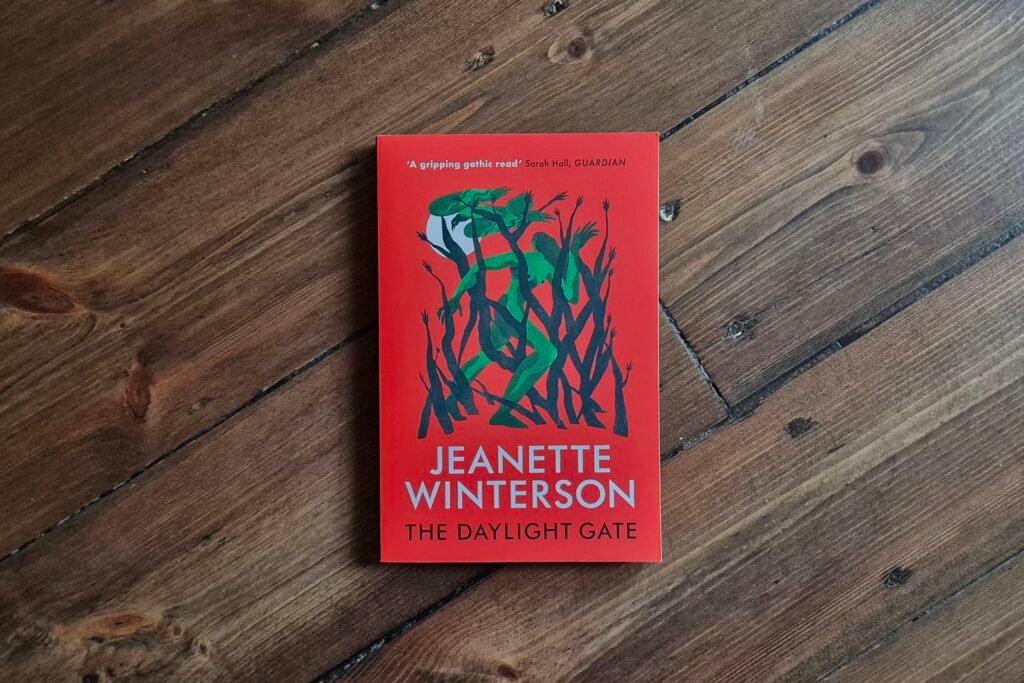
Jeanette Winterson’s body of work as a contemporary postmodernist writer undeniably epitomizes these literary qualities, “given her metanarrative, self-reflexive texts that deconstruct the divisions between fact and fiction, reality and fantasy, and masculinity and femininity, and rewrite intertextual references from the Bible to fairy tales” (Makinen, 2005). Among Winterson’s oeuvre, her novel The Daylight Gate is exemplary of her particular brand of historiographic metafiction, embodying these characteristics of Gothic-postmodernism through its creative re-imagination of the infamous Trial of the Lancashire Witches of 1612, one of the most well-documented witch trials in the history of England.
Though this witch trial was a “real” historical event, so to say, Winterson shows much self-reflexive awareness regarding the unreliability of the historical records that she used to weave her narrative, which in this case is The Wonderful Discoverie of Witches in the Countie of Lancashire, an account of the trials written by lawyer Thomas Potts, in regards to which Winterson had this to say in the preface to The Daylight Gate:
“It is supposedly an eye-witness verbatim account, though heavily dosed with Potts’ own views on the matter. Potts was loyal to James I – the fervent Protestant King whose book, Daemonology, set the tone and the feel of a century obsessed with witchcraft, and heresy of every kind – including those loyal to the old Catholic faith. Witchery popery popery witchery, as Potts put it, is how the seventeenth century English understood all matters treasonable and diabolical.” (Winterson, 2013)
Winterson has thus placed Potts within the very fabric of this narrative, not as a detached observer but as a character involved in the events, depicting him as a conceited man tempted more by the allure of glory rather than rational inquiry. Having thus laid out the religio-political interests underlying the accepted historical narrative regarding these events however, rather than attempting to uncover a deeper, more objective truth, Winterson instead pivots to a decidedly postmodernist literary gesture by telling an alternative story that “follows the historical account of the witch trials and the religious background – but with necessary speculations and inventions” (Winterson, 2013).
These speculations and inventions range from the seemingly plausible, such as the character of Alice Nutter – a noble and mysterious landowner caught up in the trials – who Winterson admits “is not the Alice Nutter of history” (Winterson, 2013), and Shakespeare’s presence at Hogton Hall at Pendle, where this story is set, along with his potential connections to so-called “witchery popery popery witchery”, to the patently fantastical, such as witchcraft, alchemy, and supernatural dealings with otherworldly spirits and devils. Presenting these latter fantastical tropes, which are more markedly devices of fiction rather than fact, right alongside the former, more plausible historical conjectures – as if they have an equally valid claim to narrative truth – reveals the textual quality of both types of speculations, thereby enacting the problematization of history that is the very aim of historiographic metafiction.
An Alternative History of the Marginalized
Winterson’s fictional reconstruction of these historical events goes “beyond accurate and objective reflection of the past”; instead, her metafiction is primarily “preoccupied with the problem of representation” (Seyrek, 2021). Winterson herself has consciously and explicitly emphasized the role that ideology plays in the process of historiography by examining the personal interests and societal biases of those who constructed it, and Özge Karip Seyrek explicates this as such:
“Historiographic metafiction reveals that during the historicising process, the historian adopts an ideological and subjective perspective that leads him to represent the dominant discourse of the period, visible in the act of suppression or exclusion of the stories of the marginalized groups such as working class, ethnic minorities, gays and women.” (Seyrek, 2021)
In direct contrast to those dominant modes of historiography, “the protagonists of historiographic metafiction are anything but proper types: they are the ex-centrics, the marginalized, the peripheral figures of fictional history” (Hutcheon, 1988); and indeed, these marginalized subjects abound in Winterson’s text, and every one of them are, without exception, tried for either witchcraft or treason.
Alice Nutter, the protagonist of The Daylight Gate, is portrayed as a capable, intelligent and righteous self-made woman, more so than any male character in the story; and it is precisely because of this that she is considered a threat to the patriarchal social order by those very men. She “embodies female agency and empowerment, thus exceeding her role as a woman within the local male-dominated environment” (Antosa, 2015), partaking in activities that are strongly associated with masculinity and manhood such as riding horses astride and with a bird. Together with her wealth, ownership of land and upper-class status which grants her freedom and independence far beyond what women of that era would normally have, she earns much suspicion from ordinary men and figures of male authority alike. As a matter of fact, this tension between Alice and her patriarchal environment has come to a head even before the story begins, as she had been previously involved in a land dispute with Roger Nowell, the local magistrate:
“Roger Nowell was a widower. Alice Nutter was a widow. They were both rich. They could have been a match. Alice’s land abutted Read Hall. But they had not courted; they had gone to law. Roger Nowell claimed a parcel of land as his. Alice Nutter claimed it as hers. She had won the lawsuit. Roger Nowell had never lost anything before – except his wife.” (Winterson, 2013)
Not only had Alice entered a dispute with a man who holds equal, if not greater power than her, she had done so after refusing to enter into a marriage with him, as had been the tradition for resolving these kinds of disputes at the time, which would have solidified her role as being subservient to him. In a later conversation between Alice and Nowell, the latter even holds this against the former as potential evidence of her involvement with witchcraft and the Devil:
“Roger Nowell held up his hand. “I have travelled in Germany and the Low Countries. Do you know the story of Faust?”
“I saw Kit Marlowe’s play Doctor Faustus when I lived in London.”
“Then you know that Faust makes a pact with Satan through his servant Mephistopheles. That pact brings immense wealth and power to those who will sign it in blood. Such men and women are unassailable. They triumph in lawsuits, for example.” (Winterson, 2013)
Thus, Winterson shows that Nowell, an otherwise (ostensibly) rational and reasonable man, who had always played the role of the magnanimous magistrate so far in the story, is just as capable as a self-interested religious zealot such as Potts of leveraging the violent tools of the patriarchy against women who step out of line, so to say, and is in fact materially incentivized into doing so. As Nowell himself put it:
“Mistress Nutter… do not mistake me. I do not much care what form of worship a man chooses, or whether his conscience is guided by a priest or his own prayers. I do not much care if a stupid old woman thinks Satan can feed her when others won’t. But I am a practical man and I have to do my duty.” (Winterson, 2013)
Alice’s reason for refusing to marry Nowell may well have been related to her queer sexuality. She had been previously involved in a romantic relationship with another woman – Elizabeth Southern – when she lived in Manchester and London, which is another one of Winterson’s wholesale inventions. Besides the fact that the queer nature of this relationship is another aspect of Alice’s character that goes against the grain of the heteropatriarchal norms and traditions of the time, there is also a strong degree narrative of juxtaposition, if not interchangeability, between that queerness and the “Great Work” of alchemy with which the two women are involved, which is dark magic and witchcraft in all but name. As Alice herself said of Elizabeth, “I learned life from her and I learned love from her as surely as I learned astrology and mathematics from John Dee and necromancy from Edward Kelley” (Winterson, 2013). Since the aim of this “Great Work” is “to dissolve all boundaries […] to transform one substance into another – one self into another” (Winterson, 2013), it follows that it would run counter to the heteropatriarchal social order that assigns rigid roles of gender and sexuality to women especially. Therefore, the illicit portrayal of queerness and other forms of transgressive sexuality in Gothic literature resonates with the liminality of its supernatural elements:
“As is frequently the case in queer Gothic, Winterson’s treatment of the tension between fantasy and realism, the uncanny dimension of existence and the material world, metaphorically evokes the tension between queer and hetero-normative perspectives. Whereas queer sexuality is associated in the novel with a secret realm of magic and illicit erotic encounters, heteronormativity is described in terms of the everyday reality of family life and church attendance.” (Palmer, 2016)
This resistance against heteropatriarchal norms, however, does not last forever, as Alice and Elizabeth are not paragon of rebellion but were themselves informed by their societal environment. They were torn apart by circumstances – arguably by the very same forces that they sought to resist – beginning with Alice’s discovery of the magenta dye that would draw the attention of the Queen and thus secure her wealth and status. One could see this as her capitulating to her greed and the allure of wealth and power, yet another activity that at that time had been the exclusive domain of men. Her participation in this patriarchal process of capital accumulation then, introduced an uneven power dynamic in her relationship with Elizabeth:
“I was at fault because I did not share everything with her. As I grew wealthier I invested my money. I bought her anything she wanted but I would not make her equal. And I was no longer interested in the Great Work. What did I care about turning lead into gold when I could turn gold into gold?” (Winterson, 2013)
This gave rise to jealousy in Elizabeth that would lead her to her contract with the Dark Gentleman (the Devil himself) and thus her downfall. Antosa argues that “this fantastic figure might be, in turn, both a symbol of a patriarchal heteronormative world that dominates women, and a cross-gendered embodied introjection of self-hatred” (Antosa, 2015).
Despite this, Alice did not completely abandon Elizabeth; in fact, it is revealed later on in the story that Old Demdike – a member of the Demdike family who was tried for witchcraft, and whom Alice had been sheltering on her property, the Malkin Tower – was none other than Elizabeth Southern herself, having become an abject figure after her downfall, and was the sole reason why Alice had been sheltering the Demdikes and the Chattoxes. Here, Winterson makes use of another Gothic-postmodernist trope by setting up Alice and Elizabeth as a double of one another:
“As desire and loss are twin-faced, so are Alice and Elizabeth: they are two specular figures, each the double of the other: the former is young and wealthy, whereas the latter is old and abject […] the former is a seductive and empowering figure, who has fought for her liberated sexuality, the latter has rejected her intellectual and lesbian life to be enslaved by the Dark Gentleman.” (Antosa, 2015)
The Abject and the Sublime
The concept of abjection, which in the words of Julia Kristeva is “radically excluded and draws [one] toward the place where meaning collapses” (Kristeva, 1982), is a crucial element in the paradigms of selfhood and representation, especially in the context of Gothic literature. The Demdikes and Chattoxes are figures of abjection par excellence, having suffered through all manners of violence, misery, deprivation, abuse and exploitation. The utterly inhumane state in which they were imprisoned in the Well Dungeon of Lancaster Castle exemplifies this:
“The prisoners are not chained. They roam around their stall […] The place stinks. Drainage is a channel cut into the earth under the straw. Their urine flows away, their faeces piled into a corner […] They are fed stale bread and brackish water twice a day. When the bread is thrown through the door, the rats squeal at it and have to be kicked away. There are four or five rats. There were more. The rest have been eaten […] Cold. The dungeon is cold and the women have only a couple of horse blankets to share between them. When it rains, the rain falls through the grating and soaks the straw underneath […] The wet straw adds to the smell of rot […] Every kind of disease is in these walls […] Day and night are the same. Fitful cold aching sleep, pain, thirst, tiredness even when asleep. The straw moves underfoot with lice. The air is stagnant. Breathing is hard because the air is so thick. Too much carbon dioxide. Not enough oxygen. Every breath keeps them alive and kills them off some more”. (Winterson, 2013)
The abject cruelty with which these accused women were treated is part of the point. The process of physical and social abjectification of the imprisoned women “is essential to maintain the coherent symbolic social order that seeks to control, exclude and suppress them, in order to confirm its ’civilised’ superiority” (Antosa, 2015). Importantly, this abjection functions on the level of historiography, for after the horrific treatment that they have gone through, the women are stripped of their agency and humanity and “are obliged to accept to be defined by the hegemonic ideology” (Seyrek, 2021); which is to say, they were paradoxically violently forced into confessing to the crimes they were accused of, and were thus recorded into history as witches. However, by choosing to portray these women in a sympathetic light, Winterson embraces her positionality with regards to her own narrative – thus further emphasizing the ideological constructedness of history – while also highlighting the historical violence that serves as the foundation of heteropatriarchal social order as the source of abject horror in her Gothic narrative.
Additionally, in Kristeva’s words, the abject is also “edged with the sublime” (Kristeva, 1982); it is closely related to the sublime experience of terror and its capacity to present the unrepresentable with which the Gothic is also fundamentally concerned. That said, Beville does put a finer point on this by emphasizing the terror of the sublime as the specific focus of Gothic-postmodernism as opposed to the horror that Kristeva associates with the abject, while also linking terror and the sublime with the liminality of the Gothic as a literary genre:
“Gothic sublimity exhibits the potential of terror in awakening the subject to its own mysterious abilities. In its dealings with sublimity, terror and selfhood, Gothic-postmodernism might be considered a liminal genre, existing on the margins between reality and unreality, self and other, fear and desire, reason and unreason, between past present and future. It often traverses these boundaries and so functions as a “third space” in literary representation, a site for fluctuations and metamorphoses, for labyrinths and the births of monsters”. (Beville, 2009)
In addition to depicting the abject horrors of patriarchy, Winterson’s counter-narrative is also shot through with sublime terror in this sense. She says of Pendle Hill that “this is a haunted place. The living and the dead come together on the hill. You cannot walk here and feel that you are alone” (Winterson, 2013). Moreover, the title of the novel itself – The Daylight Gate – is taken from a phrase that denotes a time of the day known as “the liminal hour” (Winterson, 2013), at the twilight between day and night, light and dark, life and death, where the supernatural and spiritual seemingly meet and even merge with the “real” and the material.
The sublime terror of liminality, however, manifests itself most apparently in the instances of hauntings throughout the narrative. For example, Alice went to Pendle Hill during the Daylight Gate and was there able to communicate with the spirit of John Dee, her former mentor in alchemy whom she thought had already been dead, and yet was not exactly alive, for they “are standing on a strip of time, what the Catholics call Limbo – in between the worlds of the living and the dead” (Winterson, 2013). In another scene of haunting, we see Christopher Southworth, Alice’s other lover, witness ghostly apparitions of Alice and Elizabeth in the former’s old home in London, living out their lives – or rather perhaps, their un-lives – blissfully. Despite the grim fates that Alice and Elizabeth had seemingly been met with – the former executed for witchcraft; the latter having had her soul taken by the Dark Gentleman in prison – these episodes of haunting seem to imply that they had managed to achieve the “Great Work” of alchemy. As Antosa put it, “it is through their love that they manage to dissolve corporeal, spatial and temporal boundaries to transform “one self into the other” in a queer atemporal dimension” (Antosa, 2015), which could be seen as a narrative device that embodies the possibilities of a better world and a better future that continually haunts the present of marginalized peoples.
Other Worlds, Other Histories
These other worlds and alternate realities are deeply intertwined with the counter-narrative that Winterson weaves, for they are part of “the historical plurality that negates the status of history as a master narrative that represents one single and objective truth” (Seyrek, 2021). At its most metafictional, this novel even makes this explicit through the voice of Shakespeare, a historical personage who, despite his established nature in the context of the canon of English literature, “take on different, particularized, and ultimately ex-centric status” (Hutcheon, 1988) through Winterson’s implication of his complicity with these other worlds and realities. As the playwright himself said in a conversation with Alice after the two saw The Tempest at Hoghton Hall:
“I have written about other worlds often enough. I have said what I can say. There are many kinds of reality. This is but one kind […] But, Mistress, do not be seen to stray too far from the real that is clear to others, or you may stand accused of the real that is clear to you”. (Winterson, 2013)
Once again, this highlights both the textual constructedness of historical narratives and the multiplicity of truths and realities contained within them, undermining the efforts of hegemonic forms of historiography in constructing a monolithic view of history. As an exemplar of both historiographic metafiction and Gothic-postmodernism, The Daylight Gate deconstructs hegemonic historical narratives and their ideological underpinnings while simultaneously weaving an alternative historical counter-narrative that grants a voice to marginalized and persecuted women whose stories have been suppressed and erased. It does so through a wide variety of Gothic tropes, supernatural or otherwise, undermining the boundaries between reality and fantasy, fact and fiction, self and other, and so on, underlining the endless multiplicities of truths and possibilities that can coexist within a single story, and the fact that the even the past is not set in stone, let alone the present, or the future.***
References
David Punter, Gothic Pathologies: the Text, the Body and the Law (London: Macmillan, 1998)
Hayden White, Tropics of Discourse (Baltimore: Johns Hopkins University Press, 1978)
Jeanette Winterson, The Daylight Gate (London: Penguin, 2012)
Julia Kristeva, Powers of Horror: An Essay on Abjection, trans. by Leon S. Roudiez (New York: Columbia University Press, 1982)
Linda Hutcheon, A Poetics of Postmodernism: History, Theory, Fiction (London: Routledge, 1988)
Maria Beville, Gothic-Postmodernism: Voicing the Terrors of Postmodernity (Amsterdam: BRILL, 2009)
Merja Makinen, The Novels of Jeanette Winterson (London: Bloomsbury, 2005)
Özge Karip Seyrek, ‘Jeanette Winterson’s Encounter with History: The Daylight Gate as an Example of Historiographic Metafiction’, HUMANITAS – International Journal of Social Sciences, 9.18 (2021), 151-163 <https://doi.org/10.20304/humanitas.898460>
Paulina Palmer, Queering Contemporary Gothic Narrative 1970–2012 (London: Palgrave Macmillan, 2016)
Selin Şencan, ‘Spatial Mapping, History, and the Witch in Winterson’s The Daylight Gate’, Women’s Studies, 54.2 (2024) 199–212 <https://doi-org.ntu.idm.oclc.org/10.1080/00497878.2024.2435635>
Silvia Antosa, ‘In a Queer Gothic Space and Time: Love Triangles in Jeanette Winterson’s The Daylight Gate’, Other Modernities, 13 (2015) <https://doi.org/10.13130/2035-7680/4838>
About The Author