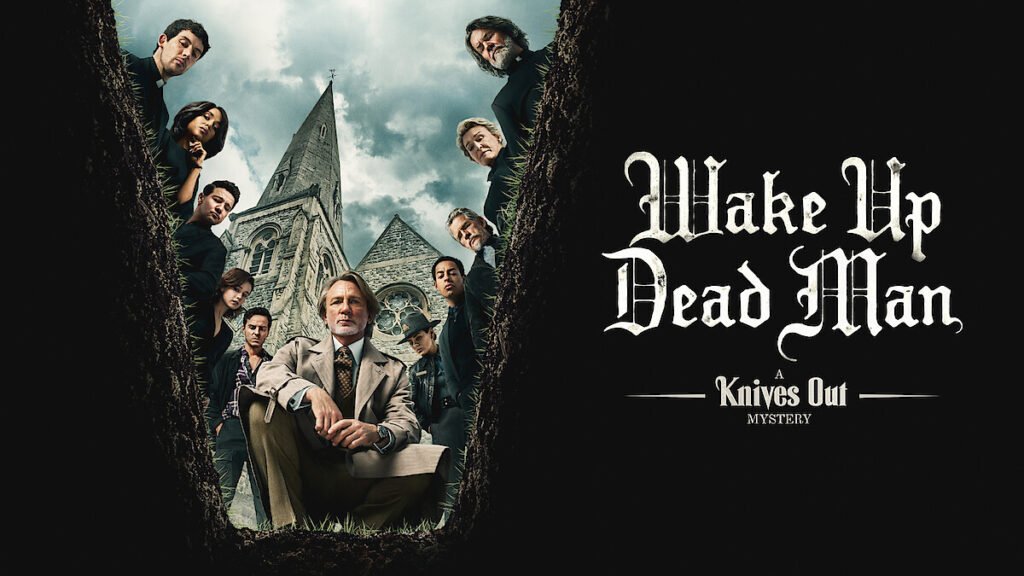
Detective fiction and religion may appear to be polar opposites of one another – one an exercise in fact-finding, the other in myth-making – but in reality, they are both modes of storytelling that are chiefly concerned with mystery and truth.
This review contains spoilers
Rian Johnson’s Knives Out series has thus far managed to consistently deliver on its novel premise of blending the classic tropes of detective fiction with settings that have a sense of timeliness to them. The elaborate locked room murder mysteries and the recurring figure of the charming, witty, idiosyncratic and slightly bumbling detective are still present, but they are placed alongside an ensemble cast of pathetic, hypocritical bigots whose bigotry reflect the political landscape of its time. That said, it is perhaps on this last point that the success of this series has been somewhat varied.
The first Knives Out is an artifact of defiant resistance against the anti-immigration politics of the first Trump administration through unabashed sympathy towards its illegal immigrant protagonist. Meanwhile, Glass Onion’s portrayal of the arrogant and hubristic billionaire (which was obviously meant to emulate Elon Musk) has aged somewhat worse, primarily due to the fact that no parody could have accurately depicted how openly idiotic and insidious he and his ilk would become in the coming years.
Wake Up Dead Man is not quite as historically specific as its two predecessors in its social commentary. Despite the smattering of more contemporary forms of bigotry, the core of this movie hits at something that is older and more enduring: the misogyny within patriarchal institutions, specifically the Catholic Church. It is precisely because of this however, that this third installment of this series is not merely a return to form, but a bold venture into a territory that the franchise had always hinted on but has never quite dared to fully commit itself to: a critical examination of the misogynistic and patriarchal underpinnings of detective fiction itself as a genre, with religion as its corollary.
The Priest and the Detective
We may begin with Benoit Blanc’s (Daniel Craig) dramatic entrance into the movie, bathed in light as he walks through the front doors of the church while Father Jud (Josh O’Connor) prostrates himself before the shadow of the cross. The exchange between the two sets out the main themes of the movie in no uncertain terms, starting with Blanc responding to Father Jud’s question of “how does all of this make you feel”, referring to the church and presumably also Catholicism in general:
“Well, the architecture, that interests me. I feel the grandeur, the… the mystery, the intended emotional effect… And it’s like someone has shone a story at me that I do not believe. It’s built upon the empty promise of a child’s fairy tale filled with malevolence and misogyny and homophobia, and it’s justified untold acts of violence and cruelty, while all the while, and still, hiding its own shameful acts. So like an ornery mule kicking back, I want to pick it apart and pop its perfidious bubble of belief and get to a truth I can swallow without choking.”
Father Jud’s rebuttal, far from contradicting Blanc’s argument, completes the thesis:
“You’re right. It’s storytelling. And this church, it’s… it’s not medieval. We’re in New York. It’s neo-Gothic 19th century. It has more in common with Disneyland than Notre Dame… and the rites and rituals and costumes, all of it. It’s storytelling. You’re right. I guess the question is, do these stories convince us of a lie? Or do they resonate with something deep inside us that’s profoundly true? That we can’t express any other way… except storytelling?”
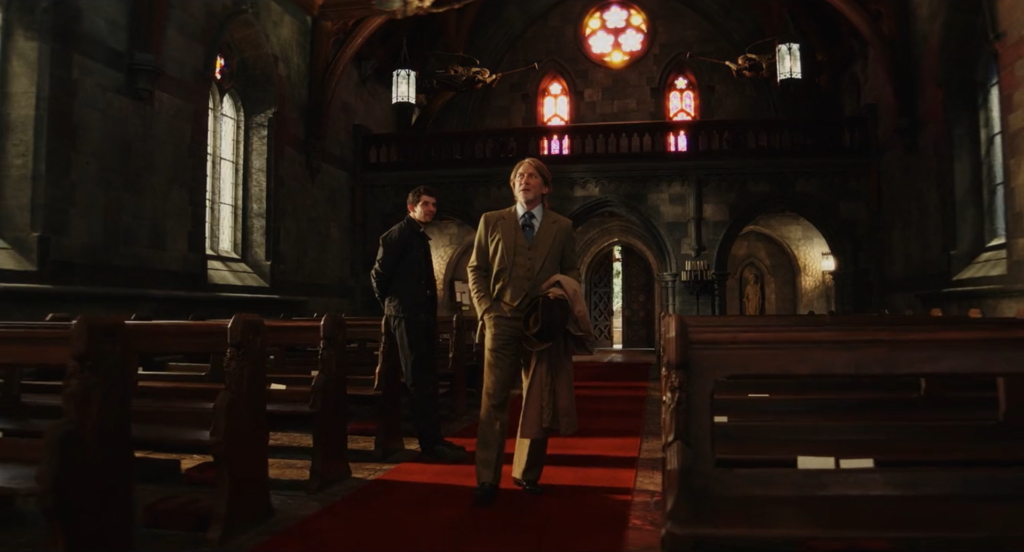
This movie is first and foremost about storytelling and its relationship with truth, a theme that lies at the heart of all detective fiction, though it is not so often examined in this way. We see this framed through the relationship between Father Jud and Blanc – the priest and the detective – the former’s struggle to find his own truth that he can only express through storytelling and the latter’s insistent, incisive and indefatigable search for a truth that is rational and objective.
This framing has been present long before that scene where Father Jud and Blanc meet for the first time. Around the halfway mark, the movie performs a relatively simple narrative sleight of hand by revealing that the events thus far had been shown through Father Jud’s perspective as he wrote out and recounted at Blanc’s request, from which Blanc deduced that Father Jud had deliberately missed out important details about Monsignor Wicks’ (Josh Brolin) whiskey flask, which he had hidden to spare Sam the groundskeeper (Thomas Haden Church) from the ugly truth of Wicks’ drinking. Storytelling, indeed.
This was all foreshadowed from the very beginning, through Father Jud’s narration that was spoken as if it was addressed to Blanc, where he mentioned that he had joined the others outside after the police arrived on the scene, which was when he returned to the crime scene to retrieve the flask. Of course, almost every detail of the story was foreshadowed just like this, since this whodunnit game has to be fair; and it is indeed a game, as Father Jud tells Blanc after his epiphany that was brough forth by his conversation with and prayer for Louise (Bridget Everett): “solving it, winning it, getting your big checkmate moment”.
This is precisely how detective fiction operates: picking out details like this, as if the story is a puzzle that can be solved, a game that can be won. Even if one is not a fan of detective fiction, the very act of engaging with this genre requires one to take on Blanc’s perspective – the perspective of the detective – picking apart needles of truth among a haystack of lies, deception and misdirection. This single-minded obsession with truth embodied by the detective ironically obscures another truth that should be obvious to us; that detective fiction, not unlike religion, is precisely that: fiction, storytelling. And what a bold parallel this is, considering how this movie depicts religion without holding back its punches.
This all comes to a head when Blanc reveals the truth that he has deduced to the entire cast; Father Jud, Geraldine the local Sherrif (Mila Kunis), and Wicks’ flock all present in Wicks’ church. Blanc takes centre stage upon Wicks’ pulpit, voice booming through the church as Wicks’ once did. His flock sits down, and they listen, for they recognize the power that Blanc holds in that moment, if not quite the voice that it speaks through. This time, the priest-detective parallel is shown not through Jud and Blanc, but through Wicks and Blanc, for Blanc has become yet another white man pontificating from his pulpit, sole voice of authority and arbiter of truth, the judge, jury and executioner of his flock.
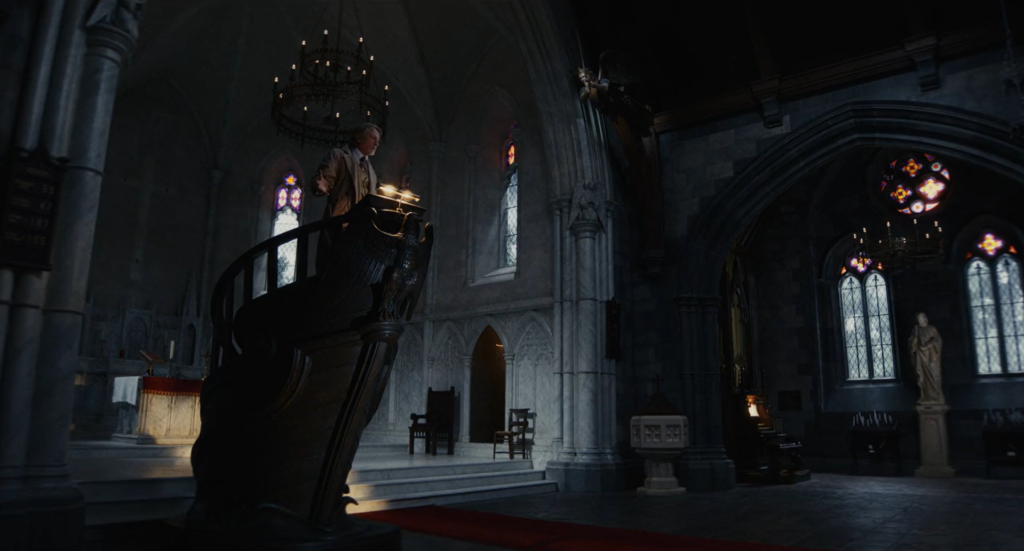
Just as Wicks’ sermons were never about Christ and all about his ego, the role of the detective all too often amounts to the size of his white male ego inflated by his power and authority in relation to the “truth” that he proclaims. Thus, it falls upon Benoit Blanc to ask himself no longer “what is the truth?”, but rather “what kind of story does he wish to tell?”, and “what kind of story is being told through him?”. He arrives at his answer through his own revelation, an epiphany inspired by Father Jud’s, playing the fool as he obscures the truth despite knowing it and taking a hit to his ego and his reputation of being “incapable of not solving a crime”. All of this is for the sake of grace; grace for the broken, for his enemy, for those who deserve it the least but need it the most: grace for the guilty. This is the story that this movie tells, one which Christianity (and detective fiction, really) should be capable of telling, yet all too often does not.
The Myth of Eve’s Apple
Grace is indeed the load-bearing fulcrum around which this narrative revolves, in more ways than one. Grace (Annie Hamilton) – as in Wicks’ mother – is seen by the characters of the movie as the “harlot whore”. This is the age-old misogynistic trope of the femme fatale, the sinful woman who is tempted by the allure of earthly desires that symbolises the very notion of temptation, a figure whom ironically has been historically denied any kind of grace by Christianity. She is instead seen as the source of the ultimate sin and evil (certainly by the church depicted in this movie), a dramatic irony that is undoubtedly a conscious creative choice by the filmmakers.
This is arguably the foundational myth of Christianity itself: the tale of Eve, who was tempted by Satan into eating the forbidden fruit and in turn tempted Adam to do the same, leading to humanity’s fall from grace and their banishment from the Garden of Eden; or so the myth of the original sin goes. This myth, along with its misogynistic implications, are systematically reproduced by the Catholic Church as a way of shaming, subjugating and controlling women, which can be seen directly in action all throughout the story of Grace’s life and death.
Grace is already shamed, at least retroactively by Martha (Glenn Close), for her obsession with “skimpy clothes” and “fancy brands”, but the ultimate mark of her shaming is the fact that she had had a child (Wicks) out of wedlock. This shame is used against her by Prentice (James Faulkner), her own father, who promised that she would inherit his wealth should she and her child remain in the care of his church, within which she presumably faces even more misogynistic shaming. This shaming is indeed misogynistic both in and of itself and for its hypocrisy, for her own son is then later revealed to have committed the very same “sin” as his mother, yet is not shamed for it. Far from it, his flock – particularly the men – close ranks to protect him.
“No shame for you”, in Vera’s (Kerry Washington) words.
The crux of this story however, is “Eve’s Apple”, the diamond within which Prentice has consolidated all his wealth, his “entire cursed fortune, all the sin in the world, all that Eve hungers for”. He swallows this gem – leading to his death – to hide it away from Grace, a final act of condemnation towards his own daughter. Prentice has clearly recreated the myth of the original sin here, casting himself both as God – the one who managed to trap all the sin of the world within a single forbidden fruit – as well as Adam, by swallowing the Apple. Meanwhile, Grace is cast as Eve, the one who hungers for that forbidden fruit, the sinful tempted temptress. Of course, there are some details here that do not match, and they reveal the hypocrisy of Christian patriarchy.
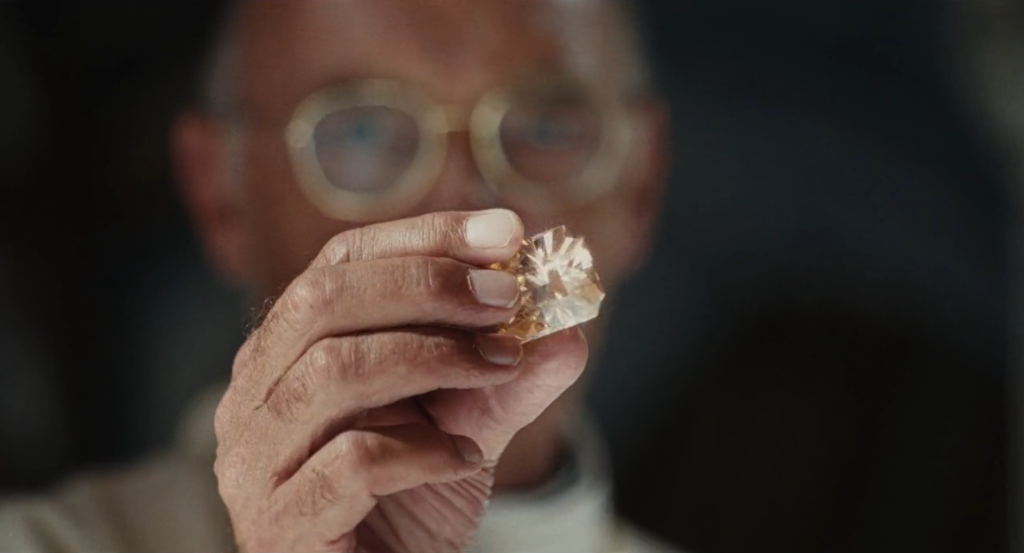
Firstly, if the Apple represents the forbidden fruit that contains all the sin of the world, then Prentice’s role is more akin to the serpent, the Devil who tempted Eve in the first place through his promise of inheritance, which turned out to be Christianity’s false and empty promise all along.
Secondly, does Prentice not guard and covet his own wealth with jealous greed, enough that he is willing to die in order to avoid giving it away even to his own daughter, to whom he promised it? Prentice’s reconstruction of the myth of the original sin then, functions as a technique of misogynistic control towards Grace – keeping her and her son within the bounds of his church, his very own walled Garden of Eden – through the false promise of inheritance, inscribing her as the locus of sin and temptation. He does this all while coveting his own wealth to the point of being willing to die to keep it to himself and unwilling to give any of it away even in death, finally masking that greed as holy virtue. Storytelling, indeed.
This then brings us to Martha, an initially unassuming character who turns out to have been the central figure connecting the disparate parts of this story together all along. We may begin with where it all started: with the lie she told, her complicity with Prentice’s mythmaking, and the darkest secret of this church that she has kept to herself, the MacGuffin that initiated this murderous chain of events; Eve’s Apple. Her motivations as a character – not only with regards to Eve’s Apple, but also her murderous conspiracy to protect it from so-called evil hands – will at last allow us to uncover both the story that she is trying to tell and the story that is being told by the movie.
From a young age and all throughout her life, Martha had undoubtedly been indoctrinated into the same misogynistic system that shamed Grace, the Madonna/whore moral dualism that led to her conceiving of herself as “the good one, the faithful one” and of Grace as the “harlot whore”. This system and the patriarchal figures who uphold it controlled her just as they controlled Grace, weighing her actions against Grace’s on a scale of judgment and decisively binding her loyalties through complicity. On top of that, this complicity is bound through trauma, for how else could one describe her witnessing the man who was like a father to her tell her his deepest secret then commit suicide right before her eyes?
It is not as if Martha is absolutely obedient to patriarchy to the point of being incapable of thinking for herself beyond the bounds of her religious indoctrination that she has absorbed perfectly. In fact, one could argue that she has a sense of justice and attachment to the church that exceeds her loyalty to Wicks, the man that she has served almost her entire life. She was even willing to kill him the moment she senses that he was about to abandon the church.
That said, it is undeniable that Martha’s motivations and culpability are directly tied to her compliance with the patriarchal power structures that have shaped her throughout her entire life. In light of all of this, it would be so easy, so trivial – a matter of course, even – to pronounce Martha as guilty and punish her sins and crimes and complicity before the eyes of the Law, both in a religious sense and in a legal sense; which, of course, Blanc was in a perfect position to do from his pulpit.
Considering the priest-detective parallels that this movie makes, the two are not as different or separate as we might think them to be. In fact, that is precisely the point, for much our legal systems were historically derived from religious law, and it largely upholds those narratives of guilt and shame and condemnation, something that we see in Father Jud’s guilt for his past crime. Instead, Blanc decides to withhold the truth that he has deduced to allow Martha herself to confess the truth from her own perspective, which contains everything she has held in her heart throughout her life – her trauma, her fear, her hatred, her guilt, and so on – to Father Jud, the one person who can understand her, the one person who has committed the same crime, the same sin. This completely changes the kind of story that is being told.
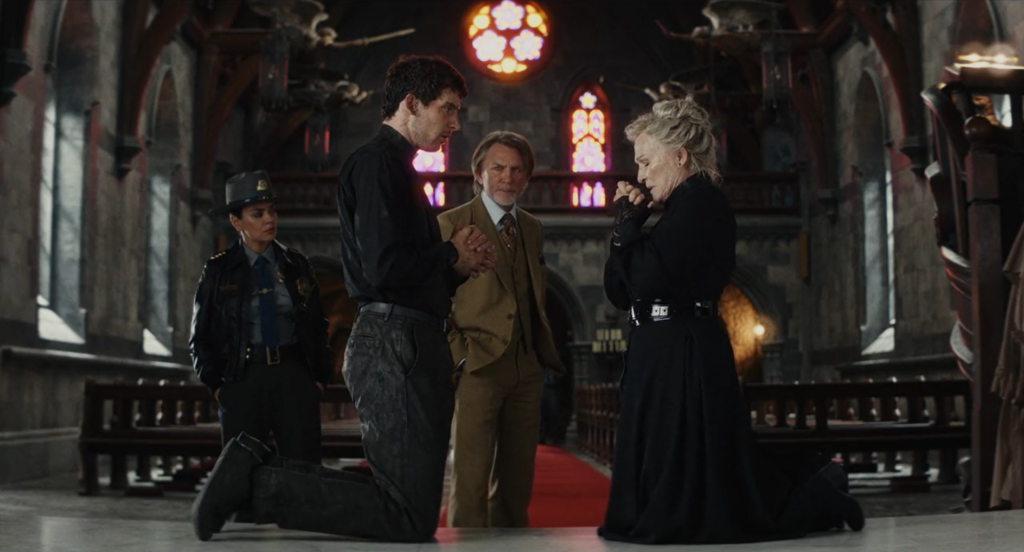
The grace, forgiveness and absolution that Father Jud offers Martha through her confession to him allows her to admit her sins without the weight of judgement that has shaped her feelings, actions and behaviour her whole life. She had always been forced to be “the good one, the faithful one”, lest she be condemned to the same fate as Grace the “harlot whore”, but here, she is allowed to exist as a human being with all her flaws and wrongdoings. Moreover, it also allows her to understand others’ imperfections (Grace’s in particular) and let go of the hatred in her heart, including the misogynistic attitude that she has towards Grace and her own internalized misogyny.
By eschewing the power structures of law, guilt, shame, condemnation and punishment that patriarchy has been built upon – which both religion and detective fiction as forms of storytelling all too often propagate – this story opens up a space for the victims of patriarchy to heal from all the pain and hatred and suffering that it has engendered. This is precisely the kind of story that Father Jud wishes to tell. Through Martha’s confession, the movie asks us, the audience, to view these people with compassion and to extend grace to those from whom grace has been historically denied.
This is what it means to have grace for the guilty.***
About The Author